Ch.5 - Stereochemistry
Wade - Organic Chemistry 9th Edition
Wade9th EditionOrganic ChemistryISBN: 9780135213728Not the one you use?Change textbook
Chapter 5, Problem 8a

A solution of 2.0 g of (+)-glyceraldehyde, HOCH2CHOHCHO, in 10.0 mL of water was placed in a 100-mm cell. Using the sodium D line, a rotation of +1.74° was found at 25 °C. Determine the specific rotation of (+)-glyceraldehyde

Verified step by step guidance
1
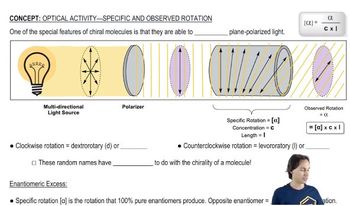
Step 1: Recall the formula for specific rotation: \( [\alpha] = \frac{\alpha}{l \cdot c} \), where \( [\alpha] \) is the specific rotation, \( \alpha \) is the observed rotation, \( l \) is the path length in decimeters, and \( c \) is the concentration in g/mL.
Step 2: Convert the path length from millimeters to decimeters. Since the cell length is 100 mm, divide by 1000 to convert to meters, then multiply by 10 to convert to decimeters. This gives \( l = 0.1 \, \text{dm} \).
Step 3: Calculate the concentration \( c \) of the solution. Divide the mass of glyceraldehyde (2.0 g) by the volume of water (10.0 mL). This gives \( c = \frac{2.0}{10.0} \, \text{g/mL} \).
Step 4: Substitute the observed rotation \( \alpha = +1.74° \), the path length \( l = 0.1 \, \text{dm} \), and the concentration \( c = 0.2 \, \text{g/mL} \) into the formula \( [\alpha] = \frac{\alpha}{l \cdot c} \).
Step 5: Simplify the expression to find the specific rotation \( [\alpha] \). Ensure units are consistent and the calculation is performed correctly.

Verified video answer for a similar problem:

This video solution was recommended by our tutors as helpful for the problem above.
Video duration:
3m
Was this helpful?

Key Concepts

Here are the essential concepts you must grasp in order to answer the question correctly.

Specific Rotation

Specific rotation is a property of chiral compounds that quantifies their ability to rotate plane-polarized light. It is defined as the observed rotation of light in degrees divided by the path length in decimeters and the concentration in grams per milliliter. The formula is [α] = α / (l × c), where [α] is the specific rotation, α is the observed rotation, l is the path length, and c is the concentration.
Recommended video:
Guided course
05:43
Specific rotation vs. observed rotation.

Chirality

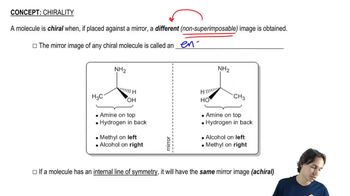
Chirality refers to the geometric property of a molecule that makes it non-superimposable on its mirror image, much like left and right hands. Chiral molecules often exist as enantiomers, which are pairs of molecules that are mirror images of each other. The presence of chiral centers, typically carbon atoms bonded to four different substituents, is a key factor in determining a molecule's optical activity.
Recommended video:
Guided course
05:10
What is chirality?

Optical Activity

Optical activity is the ability of chiral substances to rotate the plane of polarized light. This phenomenon occurs due to the asymmetric arrangement of atoms in chiral molecules. The direction and degree of rotation depend on the specific compound, its concentration, and the wavelength of light used. Measuring optical activity is crucial in determining the purity and concentration of chiral compounds in solution.
Recommended video:
Guided course
08:17
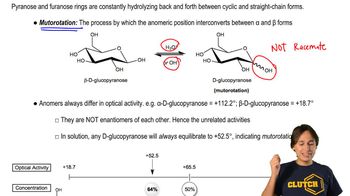
Mutorotation and Optical Activity