
Textbook Question
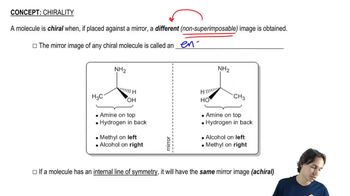
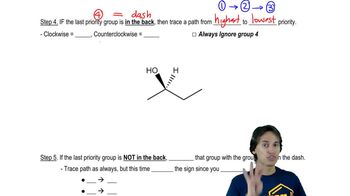
In Problem 5-3, you drew the enantiomers for a number of chiral compounds. Now go back and designate each asymmetric carbon atom as either (R) or (S).
(a)
(b)
1
views

 Verified step by step guidance
 05:10
05:10
 03:07
03:07 1:21
1:21In Problem 5-3, you drew the enantiomers for a number of chiral compounds. Now go back and designate each asymmetric carbon atom as either (R) or (S).
(a)
(b)
In Problem 5-3, you drew the enantiomers for a number of chiral compounds. Now go back and designate each asymmetric carbon atom as either (R) or (S).
(c)
(d) 1-bromo-2-methylbutane
A solution of 2.0 g of (+)-glyceraldehyde, HOCH2CHOHCHO, in 10.0 mL of water was placed in a 100-mm cell. Using the sodium D line, a rotation of +1.74° was found at 25 °C. Determine the specific rotation of (+)-glyceraldehyde
A solution of 0.50 g of (−)-epinephrine (see Figure 5-16) dissolved in 10.0 mL of dilute aqueous HCl was placed in a 20-cm polarimeter tube. Using the sodium D line, the rotation was found to be −5.1° at 25 °C. Determine the specific rotation of epinephrine.
<IMAGE>