Ch. 23 - Carbohydrates and Nucleic Acids
Wade - Organic Chemistry 9th Edition
Wade9th EditionOrganic ChemistryISBN: 9780135213728Not the one you use?Change textbook
Chapter 23, Problem 28a

Predict the products formed when the following sugars react with excess acetic anhydride and pyridine.
(a) α-D-glucopyranose

Verified step by step guidance
1
Identify the functional groups present in α-D-glucopyranose. It contains hydroxyl (-OH) groups on the sugar ring and an anomeric hydroxyl group at the C1 position.
Understand the role of acetic anhydride and pyridine. Acetic anhydride is an acetylating agent that reacts with hydroxyl groups to form acetate esters, while pyridine acts as a base to neutralize the byproduct (acetic acid) and facilitate the reaction.
Determine the number of hydroxyl groups available for reaction. In α-D-glucopyranose, there are five hydroxyl groups: one at the anomeric carbon (C1) and four on the other carbons of the sugar ring.
Predict the reaction outcome. Each hydroxyl group will react with acetic anhydride to form an acetate ester. The product will be a fully acetylated sugar, where all hydroxyl groups are replaced with acetate groups (-OCOCH₃).
Draw the structure of the product. The α-D-glucopyranose will now have acetate groups attached to all five positions where hydroxyl groups were originally present, maintaining the pyranose ring structure.

Verified video answer for a similar problem:

This video solution was recommended by our tutors as helpful for the problem above.
Video duration:
2m
Was this helpful?

Key Concepts

Here are the essential concepts you must grasp in order to answer the question correctly.

Acetic Anhydride Reactivity

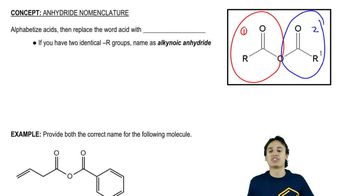
Acetic anhydride is a powerful acetylating agent used to introduce acetyl groups into organic molecules. In the presence of a base like pyridine, it reacts with hydroxyl groups on sugars, converting them into acetylated derivatives. This reaction is crucial for modifying sugars to improve their solubility and stability in various chemical processes.
Recommended video:
Guided course
03:35
Anhydride Nomenclature

Pyridine as a Catalyst

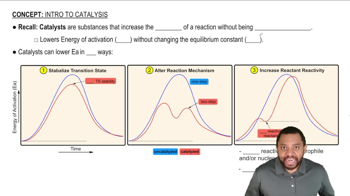
Pyridine acts as a base and catalyst in the acetylation reaction, facilitating the nucleophilic attack of the sugar's hydroxyl groups on the acetic anhydride. Its basicity helps to deprotonate the hydroxyl groups, making them more nucleophilic and enhancing the reaction rate. Understanding the role of pyridine is essential for predicting the outcome of the reaction.
Recommended video:
2:10
Introduction to Catalysis Concept 1

Sugar Structure and Reactivity

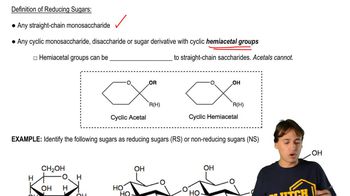
The structure of sugars, particularly their anomeric carbon and hydroxyl groups, significantly influences their reactivity. In the case of α-D-glucopyranose, the configuration at the anomeric carbon determines the specific products formed during acetylation. Recognizing how different hydroxyl groups on the sugar can react helps in predicting the final acetylated products.
Recommended video:
Guided course
02:21
Reducing Sugars