Ch. 23 - Carbohydrates and Nucleic Acids
Wade - Organic Chemistry 9th Edition
Wade9th EditionOrganic ChemistryISBN: 9780135213728Not the one you use?Change textbook
Chapter 23, Problem 30

D-Lyxose is formed by Ruff degradation of galactose. Give the structure of D-lyxose. Ruff degradation of D-lyxose gives D-threose. Give the structure of D-threose.

Verified step by step guidance
1
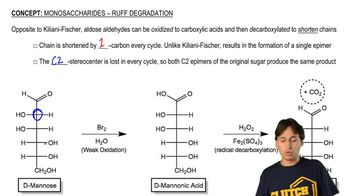
Understand the Ruff degradation process: Ruff degradation is a method used to shorten the carbon chain of an aldose sugar by one carbon atom. It involves oxidation of the aldose to an aldonic acid, followed by decarboxylation to yield a new aldose with one fewer carbon atom.
Start with D-galactose: Write the Fischer projection of D-galactose, which is an aldohexose (6-carbon sugar) with the configuration (from top to bottom): HO-C-H, H-C-OH, H-C-OH, HO-C-H, CH2OH.
Apply Ruff degradation to D-galactose: Oxidize the aldehyde group (-CHO) of D-galactose to a carboxylic acid (-COOH) to form D-galactonic acid. Then, decarboxylate the carboxylic acid group to remove one carbon atom, resulting in D-lyxose, an aldopentose (5-carbon sugar). Write the Fischer projection of D-lyxose, which has the configuration: HO-C-H, H-C-OH, H-C-OH, CH2OH.
Understand the second Ruff degradation: Apply the same Ruff degradation process to D-lyxose. Oxidize the aldehyde group of D-lyxose to form D-lyxonic acid, then decarboxylate to remove one carbon atom, yielding D-threose, an aldotetrose (4-carbon sugar).
Write the Fischer projection of D-threose: D-threose has the configuration: H-C-OH, H-C-OH, CH2OH. This is the final structure obtained after the second Ruff degradation.

Verified video answer for a similar problem:

This video solution was recommended by our tutors as helpful for the problem above.
Video duration:
5m
Was this helpful?

Key Concepts

Here are the essential concepts you must grasp in order to answer the question correctly.

Ruff Degradation

Ruff degradation is a chemical reaction that involves the oxidative cleavage of aldoses, typically using bromine and water, to yield a ketose. This process transforms an aldose sugar into a different sugar, often resulting in a sugar with fewer carbon atoms. Understanding this reaction is crucial for predicting the products formed from specific aldoses, such as galactose leading to D-lyxose.
Recommended video:
Guided course
06:18
Monosaccharides - Ruff Degradation

Sugar Structures

The structure of sugars, including their stereochemistry, is fundamental in organic chemistry. D-lyxose and D-threose are both pentoses, meaning they contain five carbon atoms, and their structures differ in the arrangement of hydroxyl groups around the chiral centers. Recognizing how to draw and interpret these structures is essential for understanding their chemical behavior and transformations.
Recommended video:
Guided course
02:21
Reducing Sugars

Stereochemistry

Stereochemistry refers to the study of the spatial arrangement of atoms in molecules and how this affects their chemical properties. In the case of D-lyxose and D-threose, the specific orientation of hydroxyl groups determines their identity and reactivity. Mastery of stereochemical concepts is vital for predicting the outcomes of reactions involving these sugars.
Recommended video:
1:38
Polymer Stereochemistry Concept 1