Ch. 23 - Carbohydrates and Nucleic Acids
Wade - Organic Chemistry 9th Edition
Wade9th EditionOrganic ChemistryISBN: 9780135213728Not the one you use?Change textbook
Chapter 23, Problem 29

Show that Ruff degradation of D-mannose gives the same aldopentose (D-arabinose) as does D-glucose.

Verified step by step guidance
1
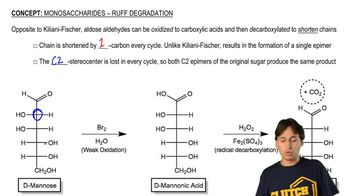
Identify the Ruff degradation process: Ruff degradation is a method used to shorten the carbon chain of an aldose sugar by one carbon atom. It involves oxidation of the aldose to an aldonic acid, followed by decarboxylation to yield a new aldose with one fewer carbon atom.
Write the structure of D-mannose and D-glucose: Both are aldohexoses, but they differ in the stereochemistry of their hydroxyl groups. D-mannose has the hydroxyl groups on C-2 and C-3 on the same side, while D-glucose has the hydroxyl group on C-2 opposite to that on C-3.
Apply Ruff degradation to D-mannose: Oxidize D-mannose to D-mannonic acid, then decarboxylate it. The resulting aldopentose will have the same stereochemistry at C-2, C-3, and C-4 as the original D-mannose, but with one fewer carbon atom. This product is D-arabinose.
Apply Ruff degradation to D-glucose: Oxidize D-glucose to D-gluconic acid, then decarboxylate it. The resulting aldopentose will have the same stereochemistry at C-2, C-3, and C-4 as the original D-glucose, but with one fewer carbon atom. This product is also D-arabinose.
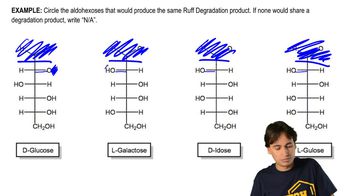
Conclude that both D-mannose and D-glucose yield the same aldopentose (D-arabinose) upon Ruff degradation, as the stereochemistry of the remaining carbons after decarboxylation is identical in both cases.

Verified video answer for a similar problem:

This video solution was recommended by our tutors as helpful for the problem above.
Video duration:
5m
Was this helpful?

Key Concepts

Here are the essential concepts you must grasp in order to answer the question correctly.

Ruff Degradation

Ruff degradation is a chemical reaction that involves the oxidative cleavage of aldoses, typically using bromine and water, to yield smaller sugar units. This process specifically targets the carbonyl group of the sugar, leading to the formation of aldopentoses from hexoses. Understanding this reaction is crucial for analyzing how D-mannose and D-glucose can both yield D-arabinose through similar pathways.
Recommended video:
Guided course
06:18
Monosaccharides - Ruff Degradation

Aldopentose

Aldopentoses are monosaccharides that contain five carbon atoms and an aldehyde functional group. D-arabinose is a specific example of an aldopentose, which can be derived from the degradation of hexoses like D-mannose and D-glucose. Recognizing the structural characteristics and properties of aldopentoses is essential for understanding the outcomes of the Ruff degradation process.
Recommended video:
Guided course
02:42
Which aldohexoses produce the same Ruff Degradation product

Isomerism in Sugars

Isomerism refers to the existence of compounds with the same molecular formula but different structural arrangements. In the context of sugars, D-mannose and D-glucose are epimers, differing at one specific carbon atom. This concept is important for understanding how different hexoses can lead to the same aldopentose product, as their structural differences can influence the degradation pathways and final products.
Recommended video:
Guided course
08:42
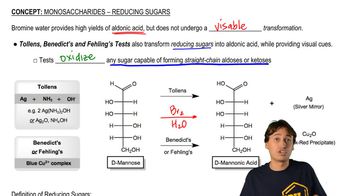
Reducing Sugars