Ch. 23 - Carbohydrates and Nucleic Acids
Wade - Organic Chemistry 9th Edition
Wade9th EditionOrganic ChemistryISBN: 9780135213728Not the one you use?Change textbook
Chapter 23, Problem 27a

Draw the expected product of the reaction of the following sugars with excess methyl iodide and silver oxide.
(a) α-D-fructofuranose

Verified step by step guidance
1
Identify the functional groups in α-D-fructofuranose. It contains hydroxyl (-OH) groups and a ketone group. These are the reactive sites in the molecule.
Understand the role of the reagents: Methyl iodide (CH₃I) is a methylating agent, and silver oxide (Ag₂O) acts as a base to facilitate the methylation reaction. The hydroxyl groups will be converted into methoxy (-OCH₃) groups.
Determine the stereochemistry of α-D-fructofuranose. The 'α' designation indicates that the anomeric hydroxyl group (on carbon-2) is in the axial position (downward in the Haworth projection). This stereochemistry will be retained in the product.
React each hydroxyl group with excess methyl iodide and silver oxide. Each hydroxyl group will be replaced with a methoxy group (-OCH₃). The ketone group on carbon-2 remains unaffected by this reaction.
Draw the final structure of the product. Ensure that all hydroxyl groups are replaced with methoxy groups, and the stereochemistry of the molecule is preserved. The product will be a fully methylated derivative of α-D-fructofuranose.

Verified video answer for a similar problem:

This video solution was recommended by our tutors as helpful for the problem above.
Video duration:
1m
Was this helpful?

Key Concepts

Here are the essential concepts you must grasp in order to answer the question correctly.

Glycosylation Reaction

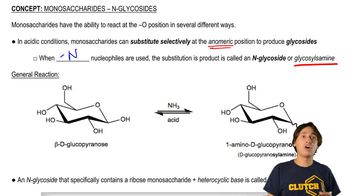
Glycosylation is a chemical reaction where a sugar molecule reacts with an alcohol or another sugar to form a glycosidic bond. In this context, the reaction of sugars with methyl iodide involves the substitution of a hydroxyl group on the sugar with a methyl group, leading to the formation of methyl glycosides. Understanding this reaction is crucial for predicting the product formed when sugars react with methyl iodide.
Recommended video:
Guided course
04:31
General Reaction

Reactivity of Sugars

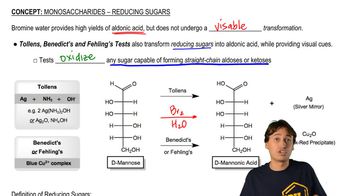
Sugars, particularly in their cyclic forms, can exhibit different reactivities based on their functional groups. In the case of a-D-fructofuranose, the presence of hydroxyl groups makes it susceptible to nucleophilic substitution reactions. Recognizing the specific functional groups and their positions on the sugar is essential for determining how the sugar will react with reagents like methyl iodide.
Recommended video:
Guided course
08:42
Reducing Sugars

Role of Silver Oxide

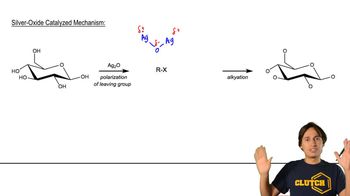
Silver oxide (Ag2O) acts as a base in organic reactions, facilitating the deprotonation of alcohols to form alkoxide ions, which are stronger nucleophiles. In the reaction with methyl iodide, silver oxide helps to enhance the nucleophilicity of the hydroxyl groups on the sugar, promoting the substitution reaction. Understanding the role of silver oxide is important for predicting the efficiency and outcome of the reaction.
Recommended video:
Guided course
03:02
Silver Oxide Catalyzed Mechanism