Ch. 19 - Amines
Wade - Organic Chemistry 9th Edition
Wade9th EditionOrganic ChemistryISBN: 9780135213728Not the one you use?Change textbook
Chapter 19, Problem 43c

The following drugs are synthesized using the methods in this chapter and in previous chapters. Devise a synthesis for each, starting with any compounds containing no more than six carbon atoms.
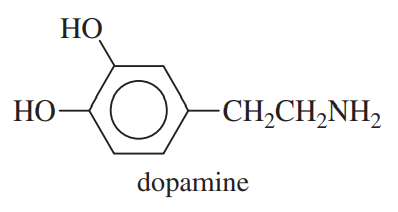
(c) Dopamine, one of the neurotransmitters in the brain. Parkinson’s disease is thought to result from a dopamine deficiency.
Chemical structure of dopamine, a neurotransmitter, showing its hydroxyl and amine functional groups.

Verified step by step guidance
1
Step 1: Analyze the structure of dopamine. Dopamine consists of a benzene ring with two hydroxyl groups (catechol structure) and a side chain containing an ethylamine group (-CH2CH2NH2). The synthesis will involve constructing the catechol ring and attaching the ethylamine side chain.
Step 2: Start with a simple benzene derivative containing no more than six carbons, such as benzene or phenol. Introduce hydroxyl groups to the benzene ring to form catechol. This can be achieved through selective hydroxylation reactions, such as using a dihydroxylation reagent like catechol synthesis from phenol.
Step 3: Prepare the ethylamine side chain. Start with a two-carbon compound such as ethylene or ethanol. Convert ethylene to ethyl bromide using bromination, and then perform a nucleophilic substitution reaction with ammonia to form ethylamine.
Step 4: Attach the ethylamine side chain to the catechol ring. This can be done through a Friedel-Crafts alkylation reaction or a Mannich reaction, which introduces the side chain to the benzene ring. Ensure the reaction conditions are controlled to avoid over-alkylation.
Step 5: Verify the final structure of dopamine. Ensure that the catechol ring has two hydroxyl groups in the correct positions and that the ethylamine side chain is attached to the benzene ring. Purify the product using techniques such as recrystallization or chromatography.

Verified video answer for a similar problem:

This video solution was recommended by our tutors as helpful for the problem above.
Video duration:
2m
Was this helpful?

Key Concepts

Here are the essential concepts you must grasp in order to answer the question correctly.

Organic Synthesis

Organic synthesis refers to the process of constructing organic compounds through chemical reactions. It involves a series of steps that transform starting materials into desired products, often requiring knowledge of reaction mechanisms, functional group transformations, and the use of reagents. Understanding the principles of organic synthesis is crucial for devising pathways to synthesize complex molecules like dopamine.
Recommended video:
1:16
Synthesis of Amino Acids: Strecker Synthesis Example 1

Functional Groups

Functional groups are specific groups of atoms within molecules that are responsible for the characteristic chemical reactions of those molecules. In the context of organic chemistry, recognizing functional groups is essential for predicting reactivity and determining the appropriate synthetic routes. For dopamine, key functional groups include amines and hydroxyls, which influence its biological activity and synthesis.
Recommended video:
Guided course
02:36
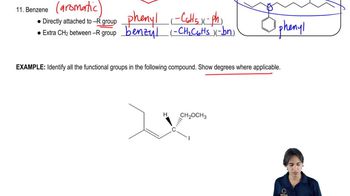
Identifying Functional Groups

Reaction Mechanisms

Reaction mechanisms describe the step-by-step sequence of elementary reactions by which overall chemical change occurs. Understanding these mechanisms is vital for predicting the products of reactions and for designing synthetic pathways. In synthesizing dopamine, knowledge of mechanisms such as nucleophilic substitutions and reductions will guide the selection of appropriate reactions to construct the molecule from simpler precursors.
Recommended video:
Guided course
02:16
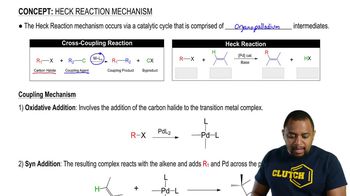
Heck Reaction Mechanism