Ch. 19 - Amines
Wade - Organic Chemistry 9th Edition
Wade9th EditionOrganic ChemistryISBN: 9780135213728Not the one you use?Change textbook
Chapter 19, Problem 43b

The following drugs are synthesized using the methods in this chapter and in previous chapters. Devise a synthesis for each, starting with any compounds containing no more than six carbon atoms.
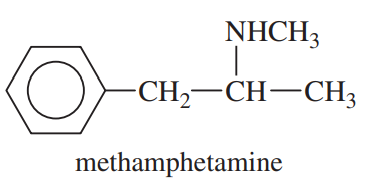
(b) Methamphetamine, once considered a safe diet pill, but now known to be addictive and destructive to brain tissue.
Chemical structure of methamphetamine, showing its molecular formula with a benzene ring and amine group.

Verified step by step guidance
1
Step 1: Analyze the target molecule, methamphetamine. It consists of a phenyl group (benzene ring) attached to a CH2 group, which is further connected to a CH group bearing a methyl group and an amine group (NHCH3). The synthesis will involve constructing this structure step by step.
Step 2: Start with benzyl chloride (C6H5CH2Cl), which contains a phenyl group and a CH2 group. Benzyl chloride can be synthesized from benzene (C6H6) via a Friedel-Crafts alkylation reaction using chloromethane (CH3Cl) and AlCl3 as a catalyst.
Step 3: Perform a nucleophilic substitution reaction on benzyl chloride to replace the chlorine atom with a cyanide group (CN). This can be achieved using sodium cyanide (NaCN) in an appropriate solvent. The product will be benzyl cyanide (C6H5CH2CN).
Step 4: Reduce the nitrile group (-CN) in benzyl cyanide to a primary amine (-CH2NH2) using a reducing agent such as lithium aluminum hydride (LiAlH4). This will yield phenyl-ethylamine (C6H5CH2CH2NH2).
Step 5: Methylate the amine group in phenyl-ethylamine to form methamphetamine. This can be done using formaldehyde (HCHO) and hydrogen gas (H2) in the presence of a catalyst such as palladium on carbon (Pd/C). The methyl group will be added to the nitrogen atom, completing the synthesis of methamphetamine.

Verified video answer for a similar problem:

This video solution was recommended by our tutors as helpful for the problem above.
Video duration:
2m
Was this helpful?

Key Concepts

Here are the essential concepts you must grasp in order to answer the question correctly.

Organic Synthesis

Organic synthesis is the process of constructing complex organic molecules from simpler ones through a series of chemical reactions. Understanding the principles of organic synthesis is crucial for devising pathways to create specific compounds, such as methamphetamine, while considering the functional groups and reaction mechanisms involved.
Recommended video:
1:16
Synthesis of Amino Acids: Strecker Synthesis Example 1

Functional Groups

Functional groups are specific groups of atoms within molecules that are responsible for the characteristic chemical reactions of those molecules. Identifying and manipulating functional groups is essential in organic synthesis, as they dictate the reactivity and properties of the compounds being synthesized, including the target drug.
Recommended video:
Guided course
02:36
Identifying Functional Groups

Reaction Mechanisms

Reaction mechanisms describe the step-by-step sequence of elementary reactions by which overall chemical change occurs. A solid grasp of reaction mechanisms is vital for predicting the outcomes of synthetic routes and for understanding how to effectively transform starting materials into the desired product, such as methamphetamine.
Recommended video:
Guided course
02:16
Heck Reaction Mechanism