
Ch. 19 - Amines
Wade - Organic Chemistry 9th Edition
Wade9th EditionOrganic ChemistryISBN: 9780135213728Not the one you use?Change textbook
Chapter 19, Problem 42g

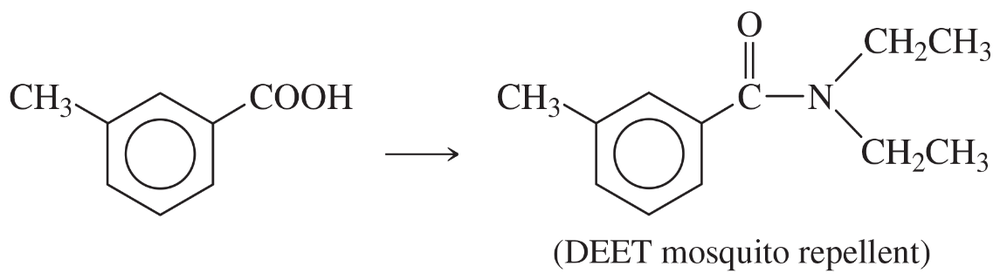
Using any necessary reagents, show how you would accomplish the following syntheses.
(g)

Verified step by step guidance
1
Step 1: Analyze the starting material and product. The starting material is a carboxylic acid, and the product is an amide. This transformation involves converting the carboxylic acid functional group (-COOH) into an amide (-CONR2).
Step 2: To convert a carboxylic acid into an amide, first activate the carboxylic acid. This can be done by converting it into an acid chloride using reagents like thionyl chloride (SOCl2) or oxalyl chloride. The reaction replaces the hydroxyl group (-OH) with a chlorine atom (-Cl), forming an acid chloride.
Step 3: Once the acid chloride is formed, it can react with an amine to form the desired amide. In this case, the amine used is diethylamine (H-N(CH2CH3)2). The nucleophilic amine attacks the carbonyl carbon of the acid chloride, leading to the formation of the amide bond.
Step 4: During the reaction between the acid chloride and the amine, a byproduct such as HCl is formed. To neutralize this byproduct, a base like pyridine or triethylamine can be added to the reaction mixture.
Step 5: After the reaction is complete, purify the product using techniques like extraction or recrystallization to isolate the desired amide.

Verified video answer for a similar problem:

This video solution was recommended by our tutors as helpful for the problem above.
Video duration:
3m
Was this helpful?

Key Concepts

Here are the essential concepts you must grasp in order to answer the question correctly.

Carboxylic Acids

Carboxylic acids are organic compounds characterized by the presence of a carboxyl group (-COOH). They are known for their acidic properties and can undergo various reactions, including esterification and conversion to acid chlorides. Understanding their structure and reactivity is crucial for predicting the outcomes of synthetic transformations.
Recommended video:
Guided course
04:20
Carboxylic Acids Nomenclature

Acid Chlorides

Acid chlorides, also known as acyl chlorides, are derivatives of carboxylic acids where the hydroxyl group is replaced by a chlorine atom. They are highly reactive and serve as important intermediates in organic synthesis, particularly in the formation of amides and esters. Recognizing their formation from carboxylic acids is essential for understanding the reaction mechanisms involved.
Recommended video:
Guided course
03:13
Acid Chloride Nomenclature

Reagents for Conversion

The conversion of carboxylic acids to acid chlorides typically involves reagents such as thionyl chloride (SOCl2), oxalyl chloride (COCl)2, or phosphorus pentachloride (PCl5). These reagents facilitate the substitution of the hydroxyl group with a chlorine atom, enabling the transformation. Familiarity with these reagents and their mechanisms is vital for successful synthesis in organic chemistry.
Recommended video:
Guided course
04:30
Comparing and contrasting the Alcohol Conversions.