Ch. 19 - Amines
Wade - Organic Chemistry 9th Edition
Wade9th EditionOrganic ChemistryISBN: 9780135213728Not the one you use?Change textbook
Chapter 19, Problem 45c

Synthesize from benzene. (Hint: All of these require diazonium ions.)
(c) 2-methyl-5-hydroxybenzoic acid

Verified step by step guidance
1
Start with benzene as the base compound. Perform a nitration reaction by treating benzene with a mixture of concentrated HNO₃ and H₂SO₄. This introduces a nitro group (-NO₂) to the benzene ring, forming nitrobenzene.
Reduce the nitro group (-NO₂) in nitrobenzene to an amino group (-NH₂) by using a reducing agent such as Sn/HCl or Fe/HCl. This forms aniline (C₆H₅NH₂).
Convert the amino group (-NH₂) in aniline to a diazonium ion (-N₂⁺) by treating it with NaNO₂ and HCl at 0–5°C. This forms benzene diazonium chloride (C₆H₅N₂⁺Cl⁻).
Perform a Sandmeyer reaction to introduce a carboxylic acid group (-COOH) at the para position relative to the diazonium group. Use CuCN followed by hydrolysis to achieve this transformation, forming para-aminobenzoic acid.
Introduce the methyl group (-CH₃) and hydroxyl group (-OH) at the appropriate positions. Use Friedel-Crafts alkylation with CH₃Cl/AlCl₃ to add the methyl group, and then perform selective hydroxylation using appropriate reagents to obtain 2-methyl-5-hydroxybenzoic acid.

Verified video answer for a similar problem:

This video solution was recommended by our tutors as helpful for the problem above.
Video duration:
14m
Was this helpful?

Key Concepts

Here are the essential concepts you must grasp in order to answer the question correctly.

Benzene and its Derivatives

Benzene is a fundamental aromatic hydrocarbon characterized by its stable ring structure and delocalized π-electrons. Understanding benzene's reactivity is crucial, as it undergoes electrophilic substitution reactions rather than addition, allowing for the introduction of various functional groups while preserving the aromatic system.
Recommended video:
Guided course
02:49
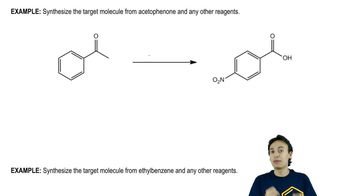
Aromatic synthesis starting with benzene/benzene derivatives

Diazonium Ions

Diazonium ions are highly reactive intermediates formed from aromatic amines and nitrous acid. They play a pivotal role in organic synthesis, particularly in electrophilic aromatic substitution reactions, where they can be used to introduce various substituents onto the benzene ring, such as hydroxyl or carboxylic acid groups.
Recommended video:
3:39
Metal Ion Catalysis Concept 1

Functional Group Transformation

Functional group transformation involves converting one functional group into another through chemical reactions. In the context of synthesizing 2-methyl-5-hydroxybenzoic acid, understanding how to manipulate functional groups, such as converting diazonium ions into hydroxyl or carboxylic acid groups, is essential for achieving the desired product.
Recommended video:
Guided course
02:36
Identifying Functional Groups