Ch. 19 - Amines
Wade - Organic Chemistry 9th Edition
Wade9th EditionOrganic ChemistryISBN: 9780135213728Not the one you use?Change textbook
Chapter 19, Problem 46a

Propose mechanisms for the following reactions.
(a)

Verified step by step guidance
1
Step 1: Analyze the starting material and reagents. The starting material is cyclopentanone, a ketone. The reagents include dimethylamine (NH(CH3)2) in the presence of acid (H+), followed by sodium triacetoxyborohydride (NaBH(OAc)3) in acetic acid (CH3COOH). This suggests an imine formation followed by reduction.
Step 2: Imine formation. The ketone reacts with dimethylamine under acidic conditions. The oxygen of the ketone is protonated by H+, increasing the electrophilicity of the carbonyl carbon. Dimethylamine then attacks the carbonyl carbon, forming a tetrahedral intermediate. This intermediate loses water to form an imine (C=N bond).
Step 3: Reduction of the imine. Sodium triacetoxyborohydride (NaBH(OAc)3) is a mild reducing agent that selectively reduces imines to amines. The imine formed in the previous step is reduced to a secondary amine, where the nitrogen is bonded to two methyl groups and the cyclopentyl group.
Step 4: Protonation and stabilization. The reaction occurs in acetic acid, which helps stabilize intermediates and ensures the reaction proceeds smoothly. The final product is a secondary amine with the structure shown in the image.
Step 5: Verify the mechanism. Ensure that all steps follow proper electron movement and that the reagents used are consistent with the transformations observed in the reaction. The final product is a secondary amine derived from cyclopentanone and dimethylamine.

Verified video answer for a similar problem:

This video solution was recommended by our tutors as helpful for the problem above.
Video duration:
8m
Was this helpful?

Key Concepts

Here are the essential concepts you must grasp in order to answer the question correctly.

Reductive Amination

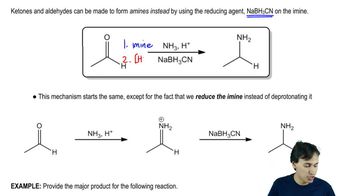
Reductive amination is a chemical reaction that involves the conversion of a carbonyl compound (like an aldehyde or ketone) into an amine. This process typically occurs in two steps: first, the carbonyl compound reacts with an amine to form an imine or enamine, followed by reduction to yield the amine. The use of reducing agents, such as sodium borohydride (NaBH4), is crucial in the second step to facilitate the reduction.
Recommended video:
Guided course
07:12
Reductive Amination

Mechanism of Imine Formation

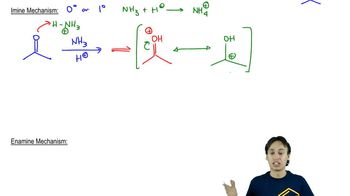
The formation of an imine from a carbonyl compound and an amine involves nucleophilic attack by the amine on the carbonyl carbon, leading to the formation of a tetrahedral intermediate. This intermediate then undergoes dehydration, releasing water and forming the imine. Understanding this mechanism is essential for predicting the behavior of the reactants and the conditions required for successful reaction completion.
Recommended video:
Guided course
06:23
Imine Mechanism

Role of Reducing Agents

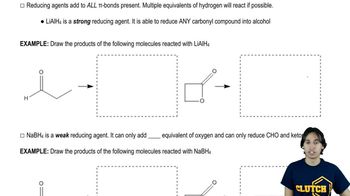
Reducing agents are substances that donate electrons to another species, reducing its oxidation state. In the context of reductive amination, sodium borohydride (NaBH4) is commonly used to reduce the imine to the corresponding amine. The choice of reducing agent can significantly affect the reaction's efficiency and selectivity, making it important to understand their properties and reactivity in organic synthesis.
Recommended video:
Guided course
09:28
Reducing Agents