
Ch. 19 - Amines
Wade - Organic Chemistry 9th Edition
Wade9th EditionOrganic ChemistryISBN: 9780135213728Not the one you use?Change textbook
Chapter 19, Problem 27

Show how to synthesize the following amines from the indicated starting materials by acylation–reduction.
(a) N-butylpiperidine from piperidine
(b) N-benzylaniline from aniline

Verified step by step guidance
1
Step 1: Understand the acylation-reduction process. Acylation involves introducing an acyl group (RCO-) to the starting material, typically using an acid chloride or anhydride. Reduction then converts the intermediate amide into the desired amine by reducing the carbonyl group to a methylene (-CH2-) group.
Step 2: For part (a), synthesizing N-butylpiperidine from piperidine: Begin by reacting piperidine with butanoyl chloride (CH3CH2CH2COCl) in the presence of a base like pyridine. This forms an amide intermediate, N-butanoylpiperidine.
Step 3: Reduce the amide intermediate (N-butanoylpiperidine) to the desired amine (N-butylpiperidine) using a reducing agent such as lithium aluminum hydride (LiAlH4). This step removes the carbonyl group, leaving a -CH2- group in its place.
Step 4: For part (b), synthesizing N-benzylaniline from aniline: React aniline (C6H5NH2) with benzoyl chloride (C6H5COCl) in the presence of a base like pyridine. This forms an amide intermediate, N-benzoylaniline.
Step 5: Reduce the amide intermediate (N-benzoylaniline) to the desired amine (N-benzylaniline) using a reducing agent such as lithium aluminum hydride (LiAlH4). This step converts the carbonyl group into a methylene (-CH2-) group, completing the synthesis.

Verified video answer for a similar problem:

This video solution was recommended by our tutors as helpful for the problem above.
Video duration:
5m
Was this helpful?

Key Concepts

Here are the essential concepts you must grasp in order to answer the question correctly.

Acylation

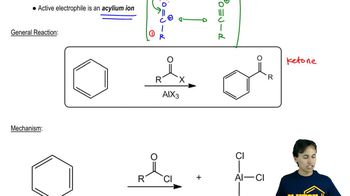
Acylation is a chemical reaction that introduces an acyl group into a molecule. In the context of amine synthesis, it typically involves the reaction of an amine with an acyl chloride or an anhydride, resulting in the formation of an N-acylated amine. This step is crucial for modifying the amine's reactivity and preparing it for subsequent reduction.
Recommended video:
Guided course
05:20
Friedel-Crafts Acylation

Reduction

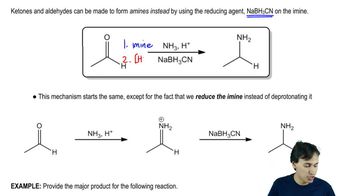
Reduction is a chemical process that involves the gain of electrons or the decrease in oxidation state of a molecule. In the synthesis of amines, the reduction step often follows acylation and can be achieved using reducing agents like lithium aluminum hydride (LiAlH4) or catalytic hydrogenation. This step converts the acylated intermediate back to the desired amine, completing the synthesis.
Recommended video:
Guided course
07:12
Reductive Amination

Amines

Amines are organic compounds derived from ammonia by replacing one or more hydrogen atoms with alkyl or aryl groups. They are classified as primary, secondary, or tertiary based on the number of carbon-containing groups attached to the nitrogen atom. Understanding the structure and reactivity of amines is essential for predicting the outcomes of acylation and reduction reactions in synthetic pathways.
Recommended video:
Guided course
07:12
Reductive Amination