Ch. 19 - Amines
Wade - Organic Chemistry 9th Edition
Wade9th EditionOrganic ChemistryISBN: 9780135213728Not the one you use?Change textbook
Chapter 19, Problem 30a

Show how you would accomplish the following synthetic conversions.
(a) benzyl bromide → benzylamine

Verified step by step guidance
1
Identify the functional group transformation: The conversion involves replacing the bromine atom in benzyl bromide with an amine group (-NH2), which is a nucleophilic substitution reaction.
Choose an appropriate nucleophile: Ammonia (NH3) is a good nucleophile for this reaction, as it can replace the bromine atom to form benzylamine.
Select the reaction conditions: Use an excess of ammonia in a polar solvent like ethanol to promote the substitution reaction. This ensures that the nucleophilic substitution proceeds efficiently.
Write the reaction mechanism: The reaction proceeds via an SN2 mechanism, where the nucleophile (NH3) attacks the carbon atom bonded to the bromine, displacing the bromine atom as a leaving group. The reaction can be represented as: C6H5CHBr+NHC6H5CHNH+HBr
Isolate and purify the product: After the reaction is complete, the benzylamine product can be separated from the reaction mixture by techniques such as extraction, followed by purification using distillation or recrystallization.

Verified video answer for a similar problem:

This video solution was recommended by our tutors as helpful for the problem above.
Video duration:
2m
Was this helpful?

Key Concepts

Here are the essential concepts you must grasp in order to answer the question correctly.

Nucleophilic Substitution

Nucleophilic substitution is a fundamental reaction in organic chemistry where a nucleophile attacks an electrophile, resulting in the replacement of a leaving group. In the conversion of benzyl bromide to benzylamine, the bromine atom acts as the leaving group, while the amine (NH2) serves as the nucleophile. Understanding this mechanism is crucial for predicting the outcome of the reaction.
Recommended video:
Guided course
01:47
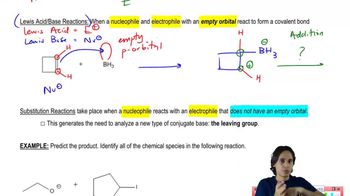
Nucleophiles and Electrophiles can react in Substitution Reactions.

Reactivity of Alkyl Halides

Alkyl halides, such as benzyl bromide, are compounds where a halogen atom is bonded to an alkyl group. The reactivity of these compounds is influenced by the nature of the halogen and the structure of the alkyl group. Benzyl bromide is particularly reactive due to the stability of the resulting carbocation during the nucleophilic substitution process, making it a suitable substrate for conversion to benzylamine.
Recommended video:
Guided course
01:52
How to name alkyl halides

Amine Nucleophilicity

Amines are organic compounds that contain a nitrogen atom bonded to hydrogen and/or carbon atoms. They are known for their nucleophilic properties, meaning they can donate a pair of electrons to form a bond with an electrophile. In the context of synthesizing benzylamine from benzyl bromide, the amine's nucleophilicity is essential for effectively attacking the electrophilic carbon in the alkyl halide, facilitating the substitution reaction.
Recommended video:
Guided course
07:12
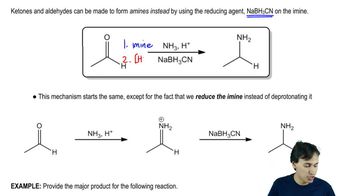
Reductive Amination