Ch. 19 - Amines
Wade - Organic Chemistry 9th Edition
Wade9th EditionOrganic ChemistryISBN: 9780135213728Not the one you use?Change textbook
Chapter 19, Problem 29a,b,c

Show how Gabriel syntheses are used to prepare the following amines.
(a) benzylamine
(b) hexan-1-amine
(c) γ-aminobutyric acid

Verified step by step guidance
1
Step 1: Understand the Gabriel synthesis. It is a method used to prepare primary amines from alkyl halides. The synthesis involves the use of phthalimide as a precursor, which reacts with an alkyl halide to form an N-alkylphthalimide intermediate. This intermediate is then hydrolyzed to yield the primary amine.
Step 2: For benzylamine (a), start by reacting phthalimide with benzyl bromide (C6H5CH2Br) in the presence of a base like KOH. This forms N-benzylphthalimide. Hydrolyze the intermediate using acid or base to release benzylamine (C6H5CH2NH2).
Step 3: For hexan-1-amine (b), react phthalimide with 1-bromohexane (C6H13Br) under similar conditions to form N-hexylphthalimide. Hydrolyze the intermediate to yield hexan-1-amine (C6H13NH2).
Step 4: For γ-aminobutyric acid (c), react phthalimide with 4-bromobutyric acid (BrCH2CH2CH2COOH). This forms N-(4-carboxybutyl)phthalimide. Hydrolyze the intermediate to yield γ-aminobutyric acid (NH2CH2CH2CH2COOH).
Step 5: Ensure proper reaction conditions for each step, such as using a suitable base for the initial reaction and appropriate hydrolysis conditions (acidic or basic) to cleave the phthalimide and release the desired amine.

Verified video answer for a similar problem:

This video solution was recommended by our tutors as helpful for the problem above.
Video duration:
9m
Was this helpful?

Key Concepts

Here are the essential concepts you must grasp in order to answer the question correctly.

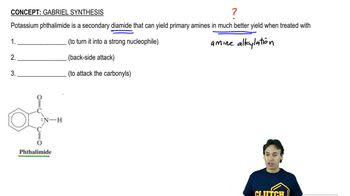
Gabriel Synthesis

Gabriel synthesis is a method used to prepare primary amines from phthalimide. The process involves the nucleophilic substitution of the phthalimide with an alkyl halide, followed by hydrolysis to yield the desired amine. This technique is particularly useful for synthesizing amines that are difficult to obtain through other methods, as it avoids the formation of secondary or tertiary amines.
Recommended video:
Guided course
04:53
General Reaction

Amines Structure and Classification

Amines are organic compounds derived from ammonia (NH3) by replacing one or more hydrogen atoms with alkyl or aryl groups. They are classified into primary, secondary, and tertiary amines based on the number of carbon-containing groups attached to the nitrogen atom. Understanding the structure of amines is crucial for predicting their reactivity and the products formed during synthesis.
Recommended video:
Guided course
07:17
Structural Classification

Functional Group Transformation

Functional group transformation refers to the process of converting one functional group into another through chemical reactions. In the context of amine synthesis, this involves the transformation of starting materials, such as phthalimide and alkyl halides, into amines. Recognizing how different functional groups can be interconverted is essential for designing synthetic pathways in organic chemistry.
Recommended video:
Guided course
02:36
Identifying Functional Groups