
Ch. 19 - Amines
Wade - Organic Chemistry 9th Edition
Wade9th EditionOrganic ChemistryISBN: 9780135213728Not the one you use?Change textbook
Chapter 19, Problem 26e

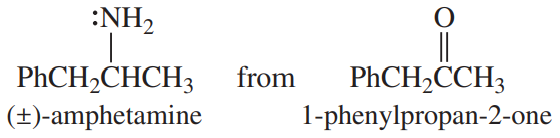
Show how to synthesize the following amines from the indicated starting materials by reductive amination.
(e) Chemical structure diagram illustrating the synthesis of (±)-amphetamine from 1-phenylpropan-2-one via reductive amination.

Verified step by step guidance
1
Step 1: Understand the process of reductive amination. Reductive amination involves the reaction of a ketone or aldehyde with an amine to form an imine intermediate, followed by reduction to yield the corresponding amine. In this case, the starting material is 1-phenylpropan-2-one (a ketone), and the target product is (±)-amphetamine (a primary amine).
Step 2: React the ketone (1-phenylpropan-2-one) with ammonia (NH₃) to form the imine intermediate. The reaction typically occurs under acidic conditions to facilitate the formation of the imine. The general reaction is: PhCH₂C(=O)CH₃ + NH₃ → PhCH₂C=NHCH₃ + H₂O.
Step 3: Reduce the imine intermediate to the amine using a reducing agent. Common reducing agents for reductive amination include sodium cyanoborohydride (NaBH₃CN) or hydrogen gas (H₂) with a metal catalyst like palladium or platinum. The reduction converts the imine (PhCH₂C=NHCH₃) to the amine (PhCH₂CH(NH₂)CH₃).
Step 4: Ensure stereochemistry is addressed. The product, (±)-amphetamine, is a racemic mixture, meaning both enantiomers are formed. This occurs because the reduction step does not favor one stereoisomer over the other.
Step 5: Purify the product. After the reaction is complete, the (±)-amphetamine can be purified using techniques such as recrystallization or chromatography to remove any impurities or unreacted starting materials.

Verified video answer for a similar problem:

This video solution was recommended by our tutors as helpful for the problem above.
Video duration:
5m
Was this helpful?

Key Concepts

Here are the essential concepts you must grasp in order to answer the question correctly.

Reductive Amination

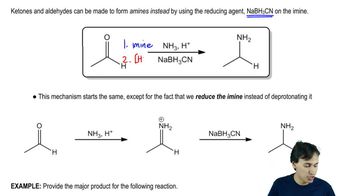
Reductive amination is a chemical reaction that involves the conversion of a carbonyl compound (like an aldehyde or ketone) into an amine. This process typically includes the formation of an imine or enamine intermediate, which is then reduced to yield the desired amine. Common reducing agents used in this reaction include sodium cyanoborohydride or hydrogen gas in the presence of a catalyst.
Recommended video:
Guided course
07:12
Reductive Amination

Carbonyl Compounds

Carbonyl compounds, which include aldehydes and ketones, are characterized by the presence of a carbon-oxygen double bond (C=O). Their reactivity is crucial in organic synthesis, as they can undergo nucleophilic addition reactions. In the context of reductive amination, the carbonyl group is essential for forming the imine intermediate when reacting with an amine.
Recommended video:
Guided course
01:40
Defining meso compounds.

Amines

Amines are organic compounds derived from ammonia (NH3) by replacing one or more hydrogen atoms with alkyl or aryl groups. They can be classified as primary, secondary, or tertiary based on the number of carbon-containing groups attached to the nitrogen atom. Amines are important in organic chemistry due to their roles in biological systems and as intermediates in the synthesis of pharmaceuticals and other chemicals.
Recommended video:
Guided course
07:12
Reductive Amination