Ch. 9 - Alkenes II: Oxidation and Reduction
Mullins - Organic Chemistry: A Learner Centered Approach 1st Edition
Mullins1st EditionOrganic Chemistry: A Learner Centered ApproachISBN: 9780137566471Not the one you use?Change textbook
Chapter 8, Problem 1a

Would you expect the following to produce an equal or unequal mixture of stereoisomers?
(a) Chemical reaction showing oxymercuration of an alkene with Hg(OAc)2, H2O, and NaBH4, forming two stereoisomers.

Verified step by step guidance
1
Identify the type of reaction or process that is being considered. Determine if it involves the formation of chiral centers or the breaking of bonds in a chiral molecule.
Examine the starting materials to see if they are chiral or achiral. This will help in predicting the stereochemical outcome of the reaction.
Consider the mechanism of the reaction. Some reactions, like SN1, can lead to racemization, producing an equal mixture of stereoisomers, while others, like SN2, typically lead to inversion of configuration.
Analyze any potential intermediates or transition states. If the reaction proceeds through a planar intermediate, such as a carbocation, it may lead to an equal mixture of stereoisomers.
Evaluate the final products. If the reaction produces a single chiral center from an achiral starting material, it may result in a racemic mixture. If multiple chiral centers are involved, consider the possibility of diastereomers and their relative configurations.

Verified video answer for a similar problem:

This video solution was recommended by our tutors as helpful for the problem above.
Video duration:
7m
Was this helpful?

Key Concepts

Here are the essential concepts you must grasp in order to answer the question correctly.

Stereoisomers

Stereoisomers are molecules that have the same molecular formula and sequence of bonded atoms, but differ in the three-dimensional orientations of their atoms in space. This concept is crucial for understanding how different spatial arrangements can lead to different chemical properties and reactivities, which is essential when predicting the outcome of reactions involving chiral centers.
Recommended video:
Guided course
01:58
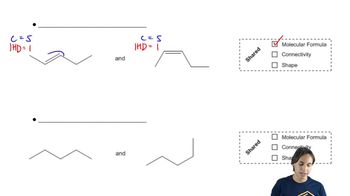
Determining when molecules are stereoisomers.

Chirality

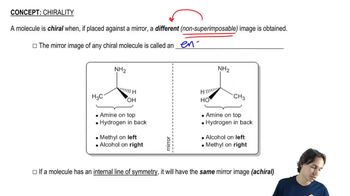
Chirality refers to the geometric property of a molecule having a non-superimposable mirror image, much like left and right hands. Molecules with chiral centers can exist as enantiomers, which are pairs of stereoisomers that are mirror images of each other. Understanding chirality is key to predicting whether a reaction will produce equal or unequal mixtures of stereoisomers.
Recommended video:
Guided course
05:10
What is chirality?

Reaction Mechanism

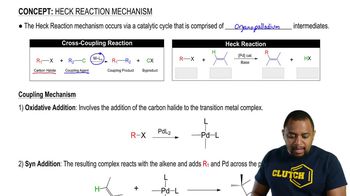
The reaction mechanism describes the step-by-step process by which reactants are transformed into products, including the formation and breaking of bonds. Knowledge of the mechanism is essential to determine whether a reaction will favor the formation of one stereoisomer over another, thus leading to an equal or unequal mixture of stereoisomers.
Recommended video:
Guided course
02:16
Heck Reaction Mechanism