Ch. 9 - Alkenes II: Oxidation and Reduction
Mullins - Organic Chemistry: A Learner Centered Approach 1st Edition
Mullins1st EditionOrganic Chemistry: A Learner Centered ApproachISBN: 9780137566471Not the one you use?Change textbook
Chapter 8, Problem 1c

Would you expect the following to produce an equal or unequal mixture of stereoisomers?
(c)

Verified step by step guidance
1
Step 1: Analyze the reaction type. The reaction shown is hydroboration-oxidation, which involves the addition of water across a double bond in an anti-Markovnikov fashion. This reaction proceeds via syn addition, meaning both the hydrogen and hydroxyl group are added to the same face of the double bond.
Step 2: Examine the starting material. The starting material is an alkene with a double bond in a symmetrical environment. The symmetry of the molecule plays a key role in determining the stereochemical outcome.
Step 3: Consider the stereochemistry of the product. Since hydroboration-oxidation proceeds via syn addition, the stereochemistry of the product depends on the spatial arrangement of the substituents around the double bond. The reaction produces two stereoisomers because the addition can occur on either face of the double bond.
Step 4: Determine if the mixture is equal or unequal. Due to the symmetry of the starting alkene, both faces of the double bond are equally accessible. This results in the formation of an equal mixture of stereoisomers.
Step 5: Conclude the stereochemical outcome. The reaction produces a racemic mixture, meaning the two stereoisomers are formed in equal amounts. This is because the starting material does not have any chiral centers or steric hindrance that would favor one face of the double bond over the other.

Verified video answer for a similar problem:

This video solution was recommended by our tutors as helpful for the problem above.
Was this helpful?

Key Concepts

Here are the essential concepts you must grasp in order to answer the question correctly.

Stereoisomerism

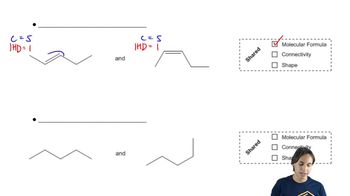
Stereoisomerism refers to the phenomenon where compounds have the same molecular formula and connectivity of atoms but differ in the spatial arrangement of their atoms. This can lead to different physical and chemical properties. In organic chemistry, stereoisomers can be classified into enantiomers and diastereomers, which are crucial for understanding reactivity and product formation in reactions.
Recommended video:
Guided course
01:58
Determining when molecules are stereoisomers.

Hydroboration-Oxidation

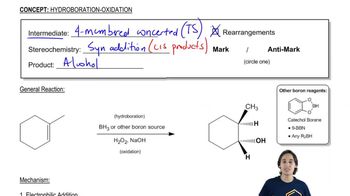
Hydroboration-oxidation is a two-step reaction process used to convert alkenes into alcohols. The first step involves the addition of borane (BH3) to the alkene, resulting in a trialkylborane intermediate. The second step involves oxidation with hydrogen peroxide and sodium hydroxide, yielding an alcohol. This reaction is stereospecific and leads to syn-addition, which is important for determining the stereochemical outcome of the product.
Recommended video:
Guided course
06:38
General properties of hydroboration-oxidation.

Chirality and Chiral Centers

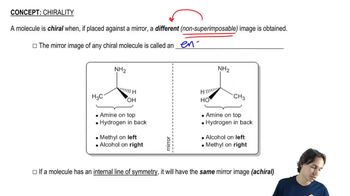
Chirality is a property of a molecule that makes it non-superimposable on its mirror image, often due to the presence of a chiral center, typically a carbon atom bonded to four different substituents. The presence of chiral centers in a molecule can lead to the formation of enantiomers, which are stereoisomers that are mirror images of each other. Understanding chirality is essential for predicting the types of stereoisomers produced in reactions like hydroboration-oxidation.
Recommended video:
Guided course
05:10
What is chirality?