Ch. 9 - Alkenes II: Oxidation and Reduction
Mullins - Organic Chemistry: A Learner Centered Approach 1st Edition
Mullins1st EditionOrganic Chemistry: A Learner Centered ApproachISBN: 9780137566471Not the one you use?Change textbook
Chapter 8, Problem 1b

Would you expect the following to produce an equal or unequal mixture of stereoisomers?
(b) Chemical reaction diagram showing acid-catalyzed hydration with products and stereoisomers indicated.

Verified step by step guidance
1
Analyze the reaction: The given reaction involves the addition of water (H₂O) in the presence of sulfuric acid (H₂SO₄) to an alkene. This is an example of an acid-catalyzed hydration reaction, which typically proceeds via a carbocation intermediate.
Determine the stereochemical implications: The alkene is planar, and the addition of water can occur from either side of the double bond. This leads to the formation of two stereoisomers, as the hydroxyl group (-OH) can be added to either face of the planar carbocation intermediate.
Examine the symmetry of the molecule: The starting alkene is symmetrical, meaning the two faces of the double bond are equivalent. This symmetry ensures that the reaction produces an equal mixture of stereoisomers (a racemic mixture).
Consider the mechanism: The reaction proceeds via the formation of a carbocation intermediate. Since the carbocation is planar, the nucleophilic attack by water can occur equally from either side, leading to the formation of both stereoisomers in equal amounts.
Conclude the stereochemical outcome: Based on the symmetry of the starting material and the planar nature of the carbocation intermediate, the reaction will produce an equal mixture of stereoisomers (racemic mixture).

Verified video answer for a similar problem:

This video solution was recommended by our tutors as helpful for the problem above.
Video duration:
8m
Was this helpful?

Key Concepts

Here are the essential concepts you must grasp in order to answer the question correctly.

Stereoisomers

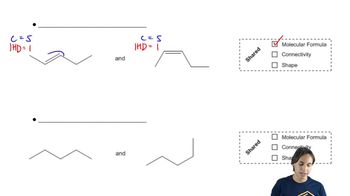
Stereoisomers are compounds that have the same molecular formula and connectivity of atoms but differ in the spatial arrangement of their atoms. This can lead to different physical and chemical properties. Understanding stereoisomerism is crucial in organic chemistry, especially in reactions involving chiral centers, where the orientation of substituents can result in distinct isomers.
Recommended video:
Guided course
01:58
Determining when molecules are stereoisomers.

Electrophilic Aromatic Substitution (EAS)

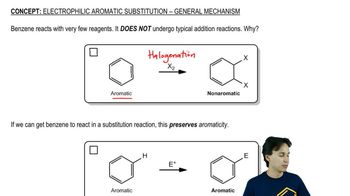
Electrophilic Aromatic Substitution is a fundamental reaction in organic chemistry where an electrophile replaces a hydrogen atom on an aromatic ring. In the provided reaction, sulfuric acid (H2SO4) acts as a catalyst, facilitating the addition of water to the aromatic compound, leading to the formation of alcohols. Recognizing the mechanism of EAS is essential for predicting the products and understanding the formation of stereoisomers.
Recommended video:

Regioselectivity

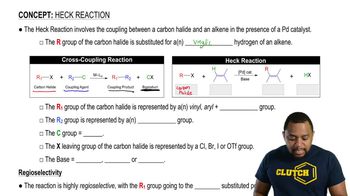
Regioselectivity refers to the preference of a chemical reaction to yield one structural isomer over others when multiple possibilities exist. In the context of the reaction shown, the orientation of the hydroxyl group (OH) on the aromatic ring can lead to different products, which may be either equal or unequal mixtures of stereoisomers depending on the stability of the intermediates formed during the reaction. This concept is vital for predicting the outcome of reactions involving substituted aromatic compounds.
Recommended video:
Guided course
05:09
Heck Reaction