Ch. 9 - Alkenes II: Oxidation and Reduction
Mullins - Organic Chemistry: A Learner Centered Approach 1st Edition
Mullins1st EditionOrganic Chemistry: A Learner Centered ApproachISBN: 9780137566471Not the one you use?Change textbook
Chapter 8, Problem 2

Show a mechanism for the formation of one isomer in each of the reactions in Assessment 9.1.
(c) Mechanism showing hydroboration reaction producing two isomers with hydroxyl groups and hydrogen atoms.

Verified step by step guidance
1
Identify the type of reaction involved. Based on Chapter 8, this is likely an electrophilic addition reaction to an alkene or alkyne. Determine the specific reagents and conditions provided in the problem to confirm the reaction type.
Draw the starting material (likely an alkene or alkyne) and the reagent. For example, if the reagent is HBr, the reaction will involve the addition of H⁺ and Br⁻ across the double or triple bond.
Propose the first step of the mechanism: The π-electrons of the double or triple bond attack the electrophile (e.g., H⁺ from HBr), forming a carbocation intermediate. Use curved arrows to show the movement of electrons.
Consider regioselectivity (Markovnikov or anti-Markovnikov addition). If the reaction follows Markovnikov's rule, the H⁺ will add to the carbon with more hydrogens, forming the more stable carbocation. If anti-Markovnikov addition is specified, the opposite occurs.
Complete the mechanism by showing the nucleophile (e.g., Br⁻) attacking the carbocation to form the final product. Ensure stereochemistry is considered if applicable, and identify the specific isomer formed in this step.

Verified video answer for a similar problem:

This video solution was recommended by our tutors as helpful for the problem above.
Video duration:
4m
Was this helpful?

Key Concepts

Here are the essential concepts you must grasp in order to answer the question correctly.

Reaction Mechanisms

A reaction mechanism is a step-by-step description of how reactants transform into products at the molecular level. It outlines the sequence of elementary steps, including bond breaking and forming, and the intermediates involved. Understanding mechanisms is crucial for predicting the products of reactions and the conditions under which they occur.
Recommended video:
Guided course
02:16
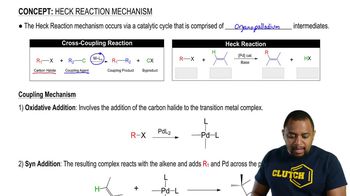
Heck Reaction Mechanism

Isomerism

Isomerism refers to the phenomenon where two or more compounds have the same molecular formula but different structural or spatial arrangements. Isomers can differ in connectivity (structural isomers) or in the orientation of atoms in space (stereoisomers). Recognizing isomers is essential for understanding the diversity of organic compounds and their reactivity.
Recommended video:
Guided course
06:47
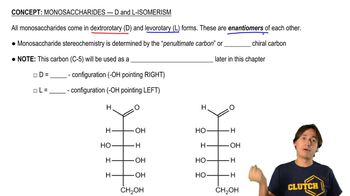
Monosaccharides - D and L Isomerism

Stereochemistry

Stereochemistry is the study of the spatial arrangement of atoms in molecules and how this affects their chemical behavior. It includes concepts such as chirality, enantiomers, and diastereomers. A solid grasp of stereochemistry is vital for predicting the outcomes of reactions that lead to specific isomers, especially in chiral environments.
Recommended video:
1:38
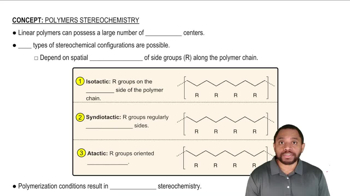
Polymer Stereochemistry Concept 1