Predict the product when the dihydroxybenzene shown is treated with a single equivalent of both base and haloalkane.
Ch. 24 - Benzene II: Reactions Influenced by the Aromatic Ring

Mullins1st EditionOrganic Chemistry: A Learner Centered ApproachISBN: 9780137566471Not the one you use?Change textbook
All textbooks
Mullins 1st Edition
Ch. 24 - Benzene II: Reactions Influenced by the Aromatic Ring
Problem 18d
Mullins 1st Edition
Ch. 24 - Benzene II: Reactions Influenced by the Aromatic Ring
Problem 18dChapter 23, Problem 18d
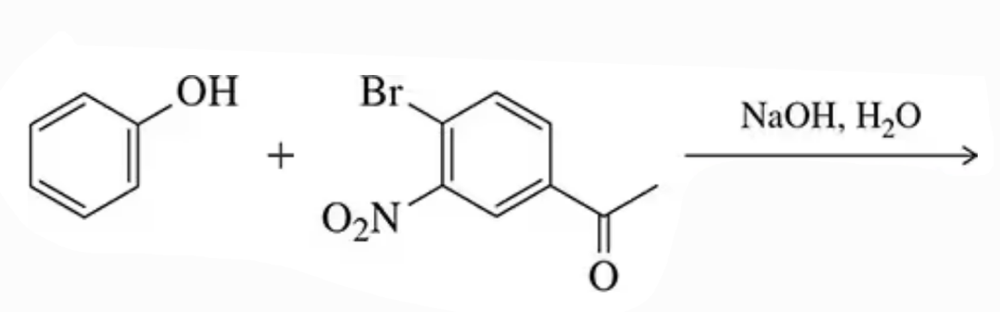
Predict the product of the following substitution/addition reactions involving phenoxides. [Because this problem represents a review of current and previous material, section numbers have been provided for your reference.]
(d) 
Verified step by step guidance1
Step 1: Analyze the reactants. The first reactant is phenol (C6H5OH), which can form phenoxide ions when treated with a strong base like NaOH. The second reactant is 4-bromo-3-nitrobenzoyl chloride, which contains an electrophilic carbonyl group and a bromine atom attached to the aromatic ring.
Step 2: Understand the role of NaOH. NaOH will deprotonate the phenol to form the phenoxide ion (C6H5O⁻), which is a strong nucleophile. This nucleophile can attack electrophilic centers in the second reactant.
Step 3: Identify the electrophilic site in the second reactant. The carbonyl carbon in the benzoyl chloride group is highly electrophilic due to the electron-withdrawing effects of the nitro group and the chlorine atom. This makes it susceptible to nucleophilic attack by the phenoxide ion.
Step 4: Predict the mechanism. The phenoxide ion will attack the carbonyl carbon of the benzoyl chloride group, leading to the formation of a tetrahedral intermediate. The chloride ion (Cl⁻) will then leave, resulting in the formation of an ester bond between the phenoxide and the benzoyl group.
Step 5: Consider the final product. The substitution reaction will yield a compound where the phenoxide group is attached to the benzoyl group, forming an ester. The bromine and nitro groups on the aromatic ring remain unchanged.

Verified video answer for a similar problem:
This video solution was recommended by our tutors as helpful for the problem above.
Was this helpful?
Key Concepts
Here are the essential concepts you must grasp in order to answer the question correctly.
Phenoxide Ion
A phenoxide ion is formed when phenol (C6H5OH) loses a proton (H+) from its hydroxyl group, resulting in a negatively charged ion (C6H5O-). This ion is a strong nucleophile due to the resonance stabilization provided by the aromatic ring, making it highly reactive in substitution and addition reactions.
Recommended video:
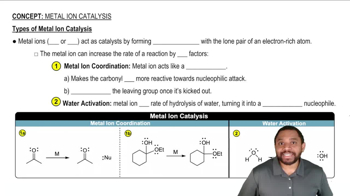
Metal Ion Catalysis Concept 1
Nucleophilic Aromatic Substitution (NAS)
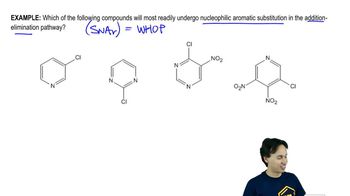
Nucleophilic aromatic substitution is a reaction where a nucleophile replaces a leaving group on an aromatic ring. This process is facilitated by the presence of electron-withdrawing groups, such as nitro (NO2) or halogens, which stabilize the negative charge in the intermediate Meisenheimer complex, allowing the nucleophile to attack the aromatic system.
Recommended video:
Guided course
NAS in the addition-elimination pathway
Reactivity of Aromatic Compounds
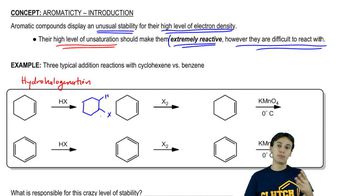
Aromatic compounds exhibit unique reactivity patterns due to their stable resonance structures. The presence of substituents can significantly influence the reactivity; electron-donating groups enhance nucleophilicity, while electron-withdrawing groups can facilitate nucleophilic attacks. Understanding these effects is crucial for predicting the outcomes of reactions involving aromatic systems.
Recommended video:
Guided course
Intro to Aromaticity
Related Practice
Textbook Question
1
views
Textbook Question
Predict the product of the following substitution/addition reactions involving phenoxides.
(a)
2
views
Textbook Question
Assessment 24.22 asked why meta-dihydroxybenzene could not be oxidized to meta-quinone. The attempted oxidation instead gives rise to three different quinone products. Suggest a mechanism for the formation of each.
3
views
Textbook Question
(a) Based on Figure 24.23, explain why meta-dihydroxybenzene is not oxidized to meta-quinone.
(b) If a meta-quinone is not produced, what would you expect the product of the oxidation of meta-dihydroxybenzene to be?
2
views
Textbook Question
In light of Figure 24.22, provide a mechanism by which para-dihydroxybenzene is oxidized to para-quinone.
1
views
Textbook Question
Suggest a phenoxide and an alkyl halide to make the following aryl alkyl ethers.
(b)
2
views