Ch. 24 - Benzene II: Reactions Influenced by the Aromatic Ring
Mullins - Organic Chemistry: A Learner Centered Approach 1st Edition
Mullins1st EditionOrganic Chemistry: A Learner Centered ApproachISBN: 9780137566471Not the one you use?Change textbook
Chapter 23, Problem 18a

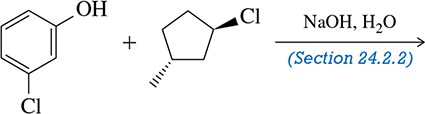
Predict the product of the following substitution/addition reactions involving phenoxides.
(a) Chemical reaction diagram showing phenol and a chlorinated compound reacting with NaOH and water.

Verified step by step guidance
1
Identify the reactants: The first reactant is a chlorophenol, specifically 2-chlorophenol, and the second reactant is a chlorocyclopentane.
Recognize the role of NaOH: Sodium hydroxide (NaOH) is a strong base that can deprotonate the phenol group, forming a phenoxide ion.
Formation of phenoxide ion: The hydroxide ion (OH-) from NaOH will deprotonate the hydroxyl group (OH) of the phenol, resulting in the formation of a phenoxide ion (C6H4ClO-).
Nucleophilic substitution: The phenoxide ion, being a good nucleophile, will attack the electrophilic carbon in the chlorocyclopentane, displacing the chloride ion (Cl-) and forming an ether linkage.
Predict the product: The final product will be an ether, specifically a phenoxycyclopentane, where the phenoxide ion has replaced the chloride ion in the cyclopentane ring.

Verified video answer for a similar problem:

This video solution was recommended by our tutors as helpful for the problem above.
Was this helpful?

Key Concepts

Here are the essential concepts you must grasp in order to answer the question correctly.

Phenoxide Ion Formation

Phenoxide ions are formed when phenol reacts with a strong base like NaOH. The hydroxyl group (OH) in phenol loses a hydrogen ion (H+), resulting in a negatively charged oxygen atom. This ion is more nucleophilic than phenol itself, making it more reactive in substitution reactions, particularly with alkyl halides.
Recommended video:
3:39
Metal Ion Catalysis Concept 1

Nucleophilic Substitution Reaction

Nucleophilic substitution is a fundamental reaction where a nucleophile replaces a leaving group in a molecule. In this reaction, the phenoxide ion acts as the nucleophile, attacking the electrophilic carbon in the chlorinated compound, displacing the chloride ion. This process is crucial for forming new carbon-oxygen bonds in organic synthesis.
Recommended video:
Guided course
01:47
Nucleophiles and Electrophiles can react in Substitution Reactions.

Stereochemistry in Substitution Reactions

Stereochemistry plays a vital role in substitution reactions, especially when the substrate is a chiral molecule. The reaction can proceed via an SN1 or SN2 mechanism, affecting the stereochemical outcome. In this case, the reaction likely follows an SN2 mechanism, leading to an inversion of configuration at the chiral center where the chloride is replaced by the phenoxide group.
Recommended video:
1:38
Polymer Stereochemistry Concept 1