Ch. 24 - Benzene II: Reactions Influenced by the Aromatic Ring
Mullins - Organic Chemistry: A Learner Centered Approach 1st Edition
Mullins1st EditionOrganic Chemistry: A Learner Centered ApproachISBN: 9780137566471Not the one you use?Change textbook
Chapter 23, Problem 22

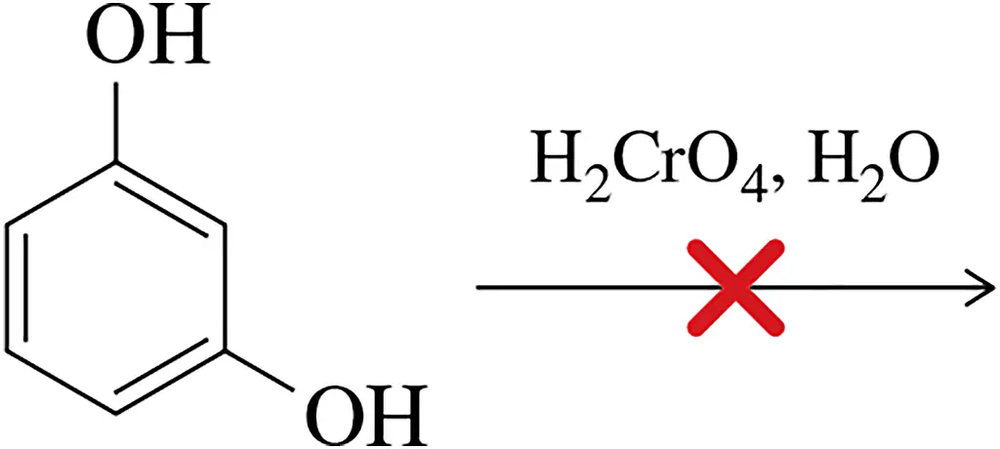
(a) Based on Figure 24.23, explain why meta-dihydroxybenzene is not oxidized to meta-quinone.
(b) If a meta-quinone is not produced, what would you expect the product of the oxidation of meta-dihydroxybenzene to be?
Chemical structure of meta-dihydroxybenzene with oxidizing agent notation and a red cross indicating no reaction.

Verified step by step guidance
1
Step 1: Analyze the structure of meta-dihydroxybenzene. It consists of a benzene ring with two hydroxyl groups attached at the meta positions (1,3-positions).
Step 2: Understand the typical oxidation process for dihydroxybenzenes. In ortho and para positions, oxidation can lead to quinones, which are cyclic diketones.
Step 3: Consider the electronic effects in meta-dihydroxybenzene. The hydroxyl groups at meta positions do not facilitate the formation of a conjugated system necessary for quinone formation, unlike ortho or para positions.
Step 4: Recognize that the lack of conjugation in meta-dihydroxybenzene prevents the stabilization of a quinone structure, hence it is not oxidized to meta-quinone.
Step 5: Predict the alternative oxidation product. Without forming a quinone, the oxidation of meta-dihydroxybenzene might lead to other products such as carboxylic acids or other oxidized forms, which will be explored in further assessments.

Verified video answer for a similar problem:

This video solution was recommended by our tutors as helpful for the problem above.
Video duration:
6m
Was this helpful?

Key Concepts

Here are the essential concepts you must grasp in order to answer the question correctly.

Dihydroxybenzene Structure

Dihydroxybenzene, also known as catechol, has two hydroxyl (-OH) groups attached to a benzene ring. The position of these groups significantly affects the compound's reactivity. In meta-dihydroxybenzene, the hydroxyl groups are located at the 1,3-positions, which influences the stability of potential oxidation products and their ability to form resonance structures.
Recommended video:
Guided course
03:04
Drawing Resonance Structures

Oxidation Mechanism

Oxidation in organic chemistry often involves the loss of electrons or the addition of oxygen. In the case of meta-dihydroxybenzene, the oxidation process may not favor the formation of meta-quinone due to steric hindrance and the electronic effects of the hydroxyl groups, which can stabilize the starting material and prevent the formation of certain products.
Recommended video:
Guided course
01:31
Oxidative Workup Mechanism:

Resonance and Stability

Resonance refers to the delocalization of electrons within a molecule, which can stabilize certain structures. In meta-dihydroxybenzene, the arrangement of hydroxyl groups does not allow for effective resonance stabilization of a meta-quinone structure. This lack of stabilization can lead to alternative oxidation products, which may be more favorable than the formation of a quinone.
Recommended video:
Guided course
03:43
The radical stability trend.