Ch. 24 - Benzene II: Reactions Influenced by the Aromatic Ring
Mullins - Organic Chemistry: A Learner Centered Approach 1st Edition
Mullins1st EditionOrganic Chemistry: A Learner Centered ApproachISBN: 9780137566471Not the one you use?Change textbook
Chapter 23, Problem 16b

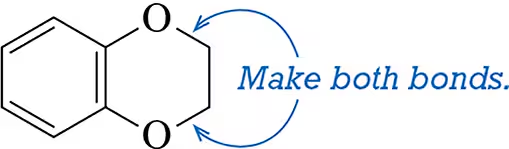
Suggest a phenoxide and an alkyl halide to make the following aryl alkyl ethers.
(b) Diagram of a benzene ring with two oxygen atoms, illustrating the concept of making both bonds in ether synthesis.

Verified step by step guidance
1
Identify the ether linkage in the given structure. The structure is a 1,4-dioxane derivative with two ether linkages.
Recognize that the ether can be synthesized by the Williamson ether synthesis, which involves the reaction of a phenoxide ion with an alkyl halide.
Determine the phenoxide ion needed. In this case, the phenoxide ion would be derived from the aromatic ring with an oxygen atom attached, specifically a catechol derivative.
Identify the alkyl halide required. The alkyl halide should correspond to the alkyl chain that forms the ether linkage. Here, a 1,2-dibromoethane can be used to form the two ether linkages.
Propose the reaction: React catechol with 1,2-dibromoethane under basic conditions to form the desired aryl alkyl ether through a double Williamson ether synthesis.

Verified video answer for a similar problem:

This video solution was recommended by our tutors as helpful for the problem above.
Was this helpful?

Key Concepts

Here are the essential concepts you must grasp in order to answer the question correctly.

Phenoxide Ion

A phenoxide ion is formed when a phenol loses a hydrogen ion (H+) from its hydroxyl group (-OH), resulting in a negatively charged oxygen atom. This ion is a strong nucleophile, making it highly reactive in nucleophilic substitution reactions. Understanding the stability and reactivity of phenoxide ions is crucial for predicting their behavior in ether formation.
Recommended video:
3:39
Metal Ion Catalysis Concept 1

Alkyl Halide

An alkyl halide is a compound derived from an alkane by replacing one or more hydrogen atoms with halogen atoms (such as chlorine, bromine, or iodine). These compounds are important in organic synthesis as they can undergo nucleophilic substitution reactions, where the halogen is replaced by a nucleophile, such as a phenoxide ion, to form ethers.
Recommended video:
Guided course
01:52
How to name alkyl halides

Williamson Ether Synthesis

Williamson ether synthesis is a method for producing ethers by reacting an alkoxide ion (derived from an alcohol) with a primary alkyl halide. This reaction typically proceeds via an SN2 mechanism, where the nucleophile attacks the electrophilic carbon of the alkyl halide, leading to the formation of an ether. Understanding this mechanism is essential for designing the synthesis of specific aryl alkyl ethers.
Recommended video:
Guided course
03:50
The Mechanism of Williamson Ether Synthesis.