Ch. 2 - General Chemistry Translated: Finding the Electrons
Mullins - Organic Chemistry: A Learner Centered Approach 1st Edition
Mullins1st EditionOrganic Chemistry: A Learner Centered ApproachISBN: 9780137566471Not the one you use?Change textbook
Chapter 1, Problem 52

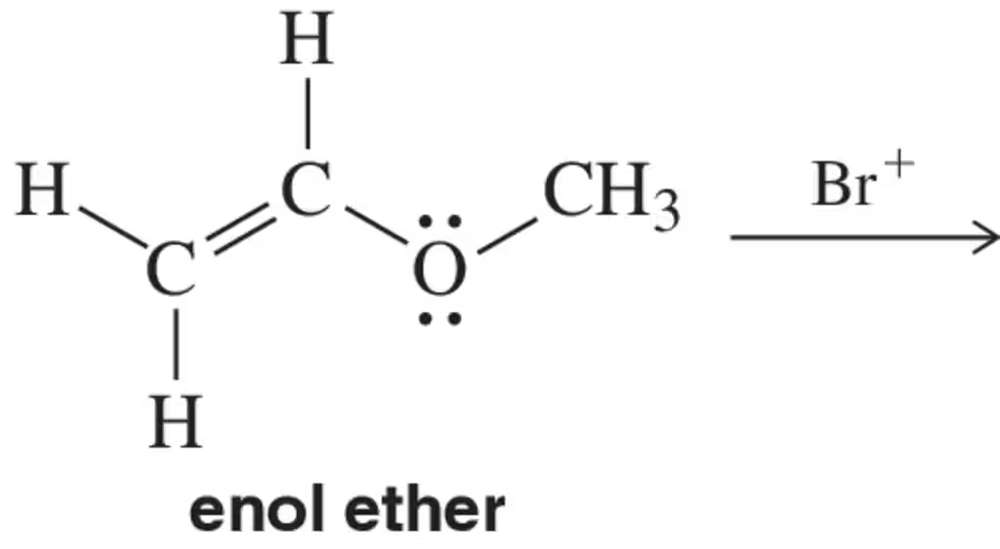
Which atoms in the enol ether would you expect to react with Br⁺ ?

Verified step by step guidance
1
Step 1: Analyze the structure of the enol ether. The enol ether contains a double bond between the two carbon atoms (C=C) and an oxygen atom bonded to one of the carbons. The oxygen atom has lone pairs of electrons, making it nucleophilic.
Step 2: Understand the reactivity of Br⁺. Bromine in its Br⁺ form is electrophilic, meaning it seeks out regions of high electron density to react with.
Step 3: Identify the regions of high electron density in the enol ether. The double bond (C=C) is electron-rich due to the π-electrons, and the oxygen atom is electron-rich due to its lone pairs.
Step 4: Predict the interaction. Br⁺ is likely to react with the π-electrons of the double bond (C=C) or the lone pairs on the oxygen atom. These are the two nucleophilic sites in the molecule.
Step 5: Consider the most likely site of attack. The double bond (C=C) is typically more reactive toward electrophiles like Br⁺ because the π-electrons are more accessible compared to the lone pairs on oxygen. However, the oxygen atom may also participate depending on the reaction conditions.

Verified video answer for a similar problem:

This video solution was recommended by our tutors as helpful for the problem above.
Was this helpful?

Key Concepts

Here are the essential concepts you must grasp in order to answer the question correctly.

Enol Ethers

Enol ethers are compounds that contain a carbon-carbon double bond (alkene) adjacent to an ether functional group (R-O-R'). They are characterized by the presence of a hydroxyl group (OH) and a carbonyl group (C=O) in their tautomeric forms. Understanding the structure of enol ethers is crucial for predicting their reactivity, particularly in electrophilic addition reactions.
Recommended video:
Guided course
02:26
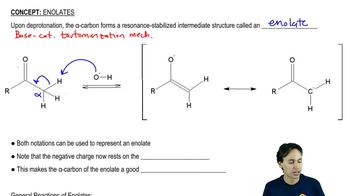
Formation of Enolates

Electrophilic Addition

Electrophilic addition is a fundamental reaction mechanism in organic chemistry where an electrophile reacts with a nucleophile, resulting in the formation of a new bond. In the context of the enol ether, the Br⁺ ion acts as an electrophile that can react with the nucleophilic sites in the molecule, such as the double bond or the oxygen atom, leading to the formation of a brominated product.
Recommended video:
Guided course
09:23
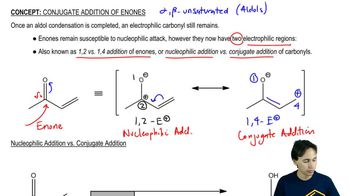
1,2 vs 1,4 Addition

Nucleophilicity of Oxygen

Oxygen in enol ethers can exhibit nucleophilic behavior due to its lone pairs of electrons. This property allows it to interact with electrophiles like Br⁺. The nucleophilicity of oxygen is significant in determining which atoms in the enol ether will react with the electrophile, influencing the overall reaction pathway and product formation.
Recommended video:
Guided course
08:27
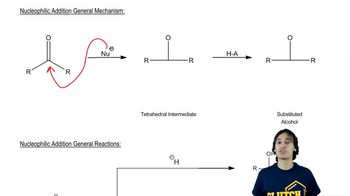
Nucleophilic Addition