Ch. 2 - General Chemistry Translated: Finding the Electrons
Mullins - Organic Chemistry: A Learner Centered Approach 1st Edition
Mullins1st EditionOrganic Chemistry: A Learner Centered ApproachISBN: 9780137566471Not the one you use?Change textbook
Chapter 1, Problem 51

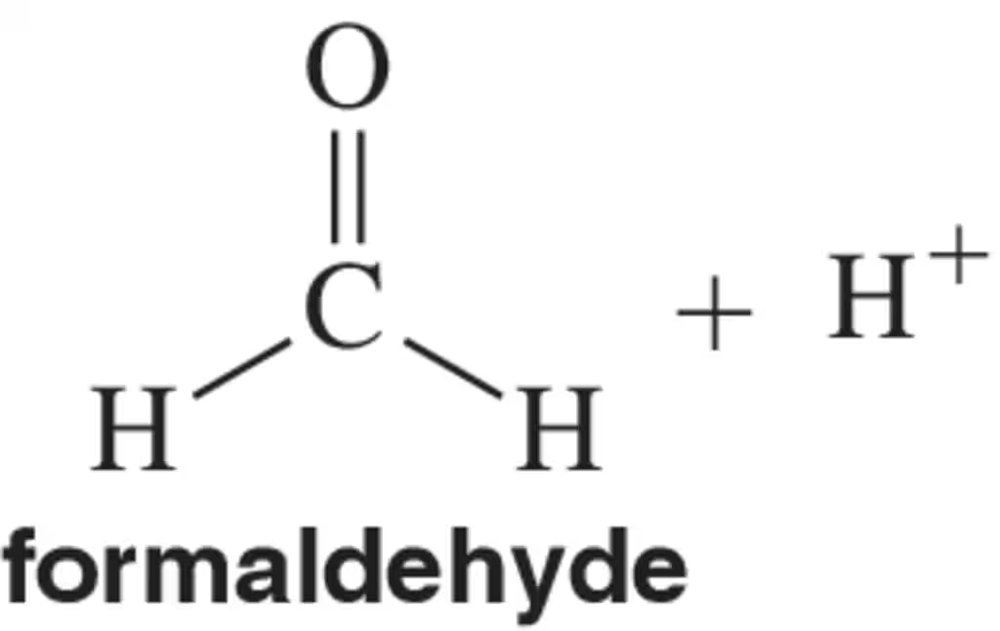
To which atom of formaldehyde would you expect H+ to add?
Structural formula of formaldehyde with H+ ion, questioning where H+ would add to the molecule.

Verified step by step guidance
1
Step 1: Begin by identifying the structure of formaldehyde. Formaldehyde has the molecular formula CH₂O and consists of a carbon atom double-bonded to an oxygen atom and single-bonded to two hydrogen atoms.
Step 2: Analyze the electronic structure of formaldehyde. The carbon atom in the carbonyl group (C=O) is partially positive due to the electronegativity difference between carbon and oxygen. Oxygen is more electronegative and pulls electron density toward itself, creating a dipole moment.
Step 3: Consider the nature of H⁺ (a proton). H⁺ is an electrophile, meaning it seeks regions of high electron density to form a bond. It will preferentially add to the atom in formaldehyde that has the highest electron density or is most nucleophilic.
Step 4: Evaluate the atoms in formaldehyde. The oxygen atom in the carbonyl group has lone pairs of electrons and is highly nucleophilic, making it the most likely site for H⁺ addition. The carbon atom is less nucleophilic due to its partial positive charge.
Step 5: Conclude that H⁺ would add to the oxygen atom of formaldehyde, forming a protonated intermediate where the oxygen atom gains a positive charge.

Verified video answer for a similar problem:

This video solution was recommended by our tutors as helpful for the problem above.
Video duration:
1m
Was this helpful?

Key Concepts

Here are the essential concepts you must grasp in order to answer the question correctly.

Electrophilic Addition

Electrophilic addition is a fundamental reaction mechanism in organic chemistry where an electrophile reacts with a nucleophile. In the case of formaldehyde, the carbon atom is electrophilic due to its partial positive charge, making it susceptible to attack by nucleophiles such as H⁺. Understanding this concept is crucial for predicting the site of protonation in carbonyl compounds.
Recommended video:
Guided course
09:23
1,2 vs 1,4 Addition

Carbonyl Group Reactivity

The carbonyl group (C=O) is a key functional group in organic chemistry, characterized by a carbon atom double-bonded to an oxygen atom. The carbon atom in the carbonyl is electrophilic, while the oxygen atom is more electronegative, creating a dipole. This polarity influences the reactivity of carbonyl compounds, including their interaction with acids like H⁺.
Recommended video:
Guided course
03:50
Intro to Carboxylic Acid Derivatives

Formaldehyde Structure

Formaldehyde (H₂C=O) is the simplest aldehyde, consisting of a carbon atom bonded to a hydrogen atom and a hydroxymethyl group. Its structure allows for unique reactivity patterns, particularly in electrophilic addition reactions. Recognizing the arrangement of atoms in formaldehyde helps in understanding how H⁺ would preferentially add to the carbon atom, leading to the formation of a more stable intermediate.
Recommended video:
Guided course
03:04
Drawing Resonance Structures