Ch. 2 - General Chemistry Translated: Finding the Electrons
Mullins - Organic Chemistry: A Learner Centered Approach 1st Edition
Mullins1st EditionOrganic Chemistry: A Learner Centered ApproachISBN: 9780137566471Not the one you use?Change textbook
Chapter 1, Problem 49a

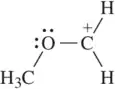
For each of the molecules shown, do the following:
(i) Identify all pushable pairs.
(ii) Identify all places where electrons can be pushed.
(iii) Draw one valid resonance structure.
(a) Molecular structure showing resonance with labeled atoms and electron pairs for analysis.

Verified step by step guidance
1
Step 1: Begin by identifying all pushable pairs in the molecule. Pushable pairs include lone pairs of electrons, π-bonds (double or triple bonds), and negative charges. Carefully examine the structure of the molecule to locate these electron sources.
Step 2: Identify all places where electrons can be pushed. These include atoms with positive charges, electron-deficient atoms (such as carbocations), and atoms that can accept electrons due to their electronegativity or hybridization. Look for regions in the molecule where electron movement can stabilize the structure.
Step 3: Apply the rules of resonance to determine valid electron movement. Electrons can be pushed from pushable pairs to electron-accepting regions, ensuring that the resulting resonance structure adheres to the octet rule and does not violate fundamental chemical principles.
Step 4: Draw one valid resonance structure based on the electron movement identified in the previous step. Ensure that the new structure maintains the correct formal charges and connectivity of atoms.
Step 5: Verify the resonance structure by checking that it is a valid representation of the molecule. Confirm that all atoms have appropriate formal charges, the octet rule is satisfied where applicable, and the structure is consistent with the original molecule.

Verified video answer for a similar problem:

This video solution was recommended by our tutors as helpful for the problem above.
Video duration:
2m
Was this helpful?

Key Concepts

Here are the essential concepts you must grasp in order to answer the question correctly.

Resonance Structures

Resonance structures are different Lewis structures for the same molecule that depict the same arrangement of atoms but differ in the distribution of electrons. These structures help illustrate the delocalization of electrons within a molecule, which can stabilize it. Understanding resonance is crucial for predicting the reactivity and properties of organic compounds.
Recommended video:
Guided course
03:04
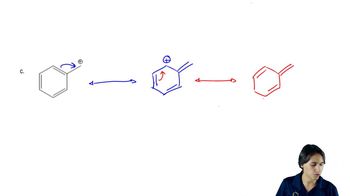
Drawing Resonance Structures

Electron Pushing (Curved Arrows)

Electron pushing is a method used in organic chemistry to show the movement of electrons during chemical reactions and resonance. Curved arrows are drawn from electron-rich areas (nucleophiles) to electron-poor areas (electrophiles) to indicate the flow of electron density. Mastery of this technique is essential for visualizing reaction mechanisms and understanding how molecular structures change.
Recommended video:
Guided course
03:54
The 18 and 16 Electron Rule

Pushable Pairs

Pushable pairs refer to pairs of electrons that can be moved in resonance structures or during reactions. These include lone pairs and pi bonds that can be shifted to form new bonds or to stabilize charges. Identifying pushable pairs is vital for constructing valid resonance structures and predicting the behavior of molecules in various chemical contexts.
Recommended video:
2:56
Base Pairing Concept 1