Ch. 2 - General Chemistry Translated: Finding the Electrons
Mullins - Organic Chemistry: A Learner Centered Approach 1st Edition
Mullins1st EditionOrganic Chemistry: A Learner Centered ApproachISBN: 9780137566471Not the one you use?Change textbook
Chapter 1, Problem 55c

How many valence electrons does each of the following contribute to a Lewis structure?
(c) B

Verified step by step guidance
1
Step 1: Recall the concept of valence electrons. Valence electrons are the electrons in the outermost shell of an atom that are involved in chemical bonding. The number of valence electrons is determined by the group number of the element in the periodic table.
Step 2: Locate boron (B) on the periodic table. Boron is in Group 13 (or Group IIIA in older notation). Elements in Group 13 have three valence electrons.
Step 3: Understand why boron has three valence electrons. Boron has an atomic number of 5, meaning it has 5 electrons in total. Its electron configuration is 1s² 2s² 2p¹. The electrons in the 2s and 2p orbitals (2s² 2p¹) are the valence electrons, totaling three.
Step 4: Apply this knowledge to a Lewis structure. In a Lewis structure, boron will contribute its three valence electrons to form bonds or lone pairs, depending on the molecule or ion it is part of.
Step 5: Verify your understanding by considering examples. For instance, in BF₃ (boron trifluoride), boron uses all three of its valence electrons to form covalent bonds with fluorine atoms.

Verified video answer for a similar problem:

This video solution was recommended by our tutors as helpful for the problem above.
Video duration:
1m
Was this helpful?

Key Concepts

Here are the essential concepts you must grasp in order to answer the question correctly.

Valence Electrons

Valence electrons are the outermost electrons of an atom and are crucial for determining how an atom will bond with others. They are involved in chemical bonding and reactions, as they can be shared or transferred between atoms. For main group elements, the number of valence electrons corresponds to the group number in the periodic table.
Recommended video:
Guided course
03:40
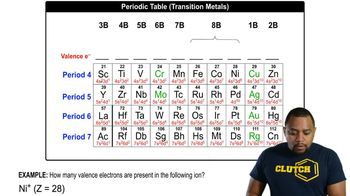
Valence Electrons of Transition Metals

Lewis Structures

Lewis structures are diagrams that represent the bonding between atoms in a molecule and the lone pairs of electrons that may exist. They use dots to represent valence electrons and lines to represent bonds between atoms. Understanding how to draw and interpret Lewis structures is essential for visualizing molecular geometry and predicting reactivity.
Recommended video:
Guided course
04:12
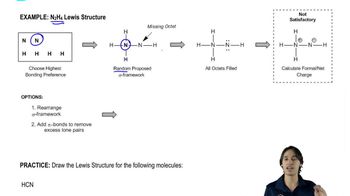
Drawing the Lewis Structure for N2H4.

Boron in Lewis Structures

Boron is a group 13 element with three valence electrons. In Lewis structures, it typically forms three covalent bonds to achieve a stable electron configuration. However, boron can also form electron-deficient compounds, where it does not complete an octet, making it unique among the main group elements.
Recommended video:
Guided course
04:12
Drawing the Lewis Structure for N2H4.