Ch. 19 - Nucleophilic Acyl Substitution II: Carboxylic Acid Derivatives
Mullins - Organic Chemistry: A Learner Centered Approach 1st Edition
Mullins1st EditionOrganic Chemistry: A Learner Centered ApproachISBN: 9780137566471Not the one you use?Change textbook
Chapter 18, Problem 59b

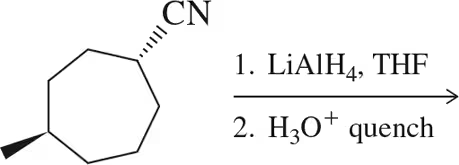
Predict the product of the following reaction sequences.
(b) Chemical reaction sequence showing a cyclic compound with a cyano group, followed by reduction steps using LiAlH4 and quenching with H3O+.

Verified step by step guidance
1
Identify the functional group present in the starting material. The starting material is a nitrile, characterized by the -CN group.
Recognize the reagents used in the reaction. Lithium aluminum hydride (LiAlH4) is a strong reducing agent, and tetrahydrofuran (THF) is a common solvent for such reductions.
Understand the role of LiAlH4 in the reaction. LiAlH4 will reduce the nitrile group (-CN) to a primary amine (-CH2NH2).
Consider the second step of the reaction sequence. The addition of H3O+ (acidic workup) is used to quench the reaction, ensuring the complete conversion of the intermediate to the final product.
Predict the structure of the final product. The nitrile group will be reduced to a primary amine, resulting in a cyclohexylamine derivative.

Verified video answer for a similar problem:

This video solution was recommended by our tutors as helpful for the problem above.
Video duration:
2m
Was this helpful?

Key Concepts

Here are the essential concepts you must grasp in order to answer the question correctly.

Reaction Mechanisms

Understanding reaction mechanisms is crucial in organic chemistry as they describe the step-by-step process by which reactants transform into products. This includes identifying intermediates, transition states, and the movement of electrons. A clear grasp of mechanisms helps predict the outcome of reactions and the stability of products formed.
Recommended video:
Guided course
02:16
Heck Reaction Mechanism

Functional Groups

Functional groups are specific groups of atoms within molecules that are responsible for the characteristic chemical reactions of those molecules. Recognizing functional groups allows chemists to predict reactivity and the types of reactions that can occur. For example, alcohols, carboxylic acids, and amines each have distinct behaviors in chemical reactions.
Recommended video:
Guided course
02:36
Identifying Functional Groups

Stereochemistry

Stereochemistry involves the study of the spatial arrangement of atoms in molecules and how this affects their chemical behavior. It is essential for predicting the products of reactions, especially in cases where chirality is involved. Understanding stereochemical principles helps in determining the configuration of products and their potential biological activity.
Recommended video:
1:38
Polymer Stereochemistry Concept 1