Ch. 19 - Nucleophilic Acyl Substitution II: Carboxylic Acid Derivatives
Mullins - Organic Chemistry: A Learner Centered Approach 1st Edition
Mullins1st EditionOrganic Chemistry: A Learner Centered ApproachISBN: 9780137566471Not the one you use?Change textbook
Chapter 18, Problem 60

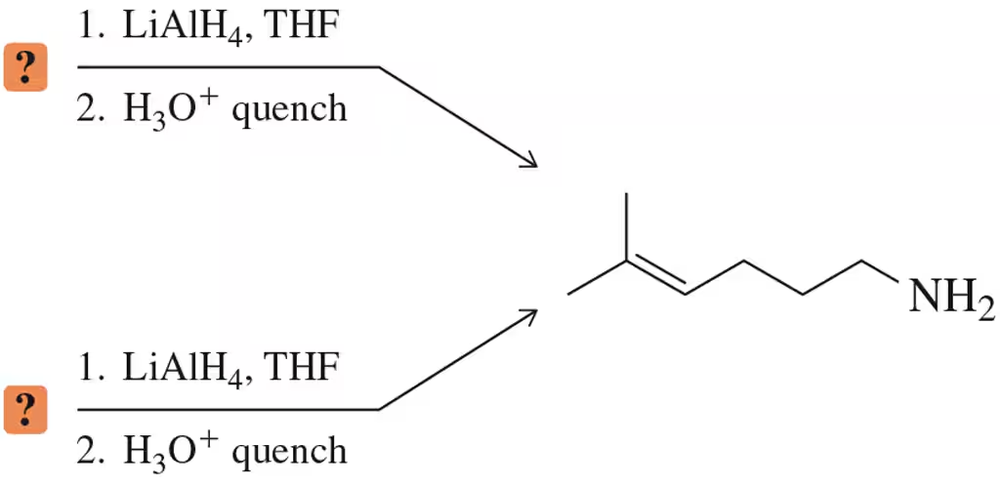
Reduction of two different carboxylic acid derivatives with LiAlH₄ would give the amine shown. Identify these carboxylic acid derivatives.
Reduction of two carboxylic acid derivatives with LiAlH₄ to form an amine with a branched alkene chain.

Verified step by step guidance
1
Understand that LiAlH₄ (Lithium aluminum hydride) is a strong reducing agent commonly used to reduce carboxylic acid derivatives to alcohols or amines.
Recognize that the reduction of carboxylic acid derivatives to amines typically involves the conversion of amides or nitriles.
Consider that amides (RCONH₂) can be reduced by LiAlH₄ to primary amines (RCH₂NH₂).
Consider that nitriles (RCN) can also be reduced by LiAlH₄ to primary amines (RCH₂NH₂).
Identify that the two carboxylic acid derivatives that can be reduced to the same amine are likely an amide and a nitrile, both having the same carbon skeleton as the resulting amine.

Verified video answer for a similar problem:

This video solution was recommended by our tutors as helpful for the problem above.
Video duration:
3m
Was this helpful?

Key Concepts

Here are the essential concepts you must grasp in order to answer the question correctly.

Carboxylic Acid Derivatives

Carboxylic acid derivatives are compounds that can be converted into carboxylic acids through hydrolysis. They include esters, amides, anhydrides, and acyl chlorides. Understanding their reactivity and transformation is crucial for predicting the products of reduction reactions.
Recommended video:
Guided course
03:50
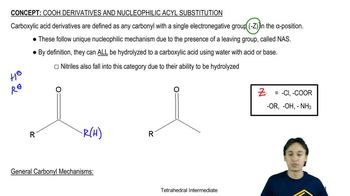
Intro to Carboxylic Acid Derivatives

Reduction with LiAlH₄

Lithium aluminum hydride (LiAlH₄) is a strong reducing agent used in organic chemistry to convert carboxylic acid derivatives into alcohols or amines. It is particularly effective in reducing esters and amides to primary alcohols and amines, respectively, by breaking the carbon-oxygen or carbon-nitrogen bonds.
Recommended video:
Guided course
07:12
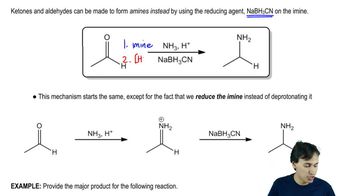
Reductive Amination

Amine Formation

Amines are organic compounds derived from ammonia by replacement of one or more hydrogen atoms with organic groups. In the context of reduction, amines can be formed from amides or nitriles when treated with LiAlH₄, which reduces the carbonyl group to a methylene group, resulting in the formation of primary amines.
Recommended video:
Guided course
07:12
Reductive Amination