Ch. 19 - Nucleophilic Acyl Substitution II: Carboxylic Acid Derivatives
Mullins - Organic Chemistry: A Learner Centered Approach 1st Edition
Mullins1st EditionOrganic Chemistry: A Learner Centered ApproachISBN: 9780137566471Not the one you use?Change textbook
Chapter 18, Problem 69

On a day in which the laboratory air conditioning stopped working, a chemist hypothesized that the atmosphere would provide enough ambient heat to drive the nitrile hydrolysis reaction to the carboxylic acid. Based on the IR of the resulting product, was this hypothesis correct?
<IMAGE>

Verified step by step guidance
1
Step 1: Understand the reaction. Nitrile hydrolysis involves converting a nitrile group (R-C≡N) into a carboxylic acid (R-COOH) using water and heat. The reaction typically requires acidic or basic conditions and sufficient heat to proceed.
Step 2: Consider the role of IR spectroscopy. Infrared (IR) spectroscopy is used to identify functional groups in a compound based on the absorption of infrared light at specific wavelengths. Each functional group has characteristic absorption bands.
Step 3: Identify key IR absorption bands. For nitriles, the C≡N stretch typically appears around 2210-2260 cm⁻¹. For carboxylic acids, the C=O stretch appears around 1700-1750 cm⁻¹, and the O-H stretch appears broadly around 2500-3300 cm⁻¹.
Step 4: Analyze the IR spectrum of the product. Check for the disappearance of the nitrile peak and the appearance of the carboxylic acid peaks. The presence of a strong C=O stretch and a broad O-H stretch would indicate successful conversion to a carboxylic acid.
Step 5: Conclude based on IR data. If the IR spectrum shows the expected carboxylic acid peaks and the nitrile peak is absent, the hypothesis that ambient heat was sufficient for the reaction is supported. Otherwise, further investigation is needed.

Verified video answer for a similar problem:

This video solution was recommended by our tutors as helpful for the problem above.
Video duration:
3m
Was this helpful?

Key Concepts

Here are the essential concepts you must grasp in order to answer the question correctly.

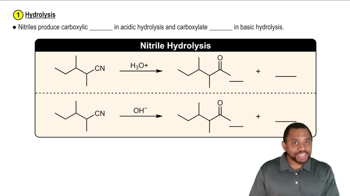
Nitrile Hydrolysis

Nitrile hydrolysis is a chemical reaction where a nitrile is converted into a carboxylic acid. This process typically requires acidic or basic conditions and heat to proceed efficiently. Understanding the mechanism involves recognizing the nucleophilic attack on the carbon of the nitrile group, leading to the formation of an amide intermediate, which further hydrolyzes to yield the carboxylic acid.
Recommended video:
1:09
Review of Nitriles Concept 6

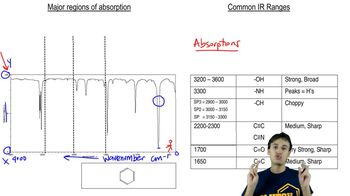
Infrared (IR) Spectroscopy

IR spectroscopy is an analytical technique used to identify functional groups in a molecule by measuring the absorption of infrared light at different wavelengths. Each functional group, such as nitriles or carboxylic acids, has characteristic absorption bands. For instance, nitriles show a sharp peak around 2250 cm⁻¹, while carboxylic acids exhibit broad peaks around 2500-3300 cm⁻¹ due to O-H stretching.
Recommended video:
Guided course
16:04
General Features of IR Spect

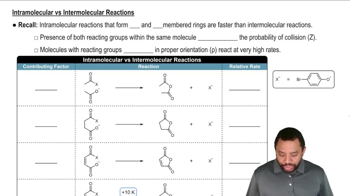
Effect of Temperature on Reaction Rate

Temperature is a critical factor influencing the rate of chemical reactions. Higher temperatures generally increase reaction rates by providing the necessary energy to overcome activation barriers. In the context of the nitrile hydrolysis, ambient heat from a non-air-conditioned environment might be sufficient to drive the reaction, depending on the specific energy requirements of the process.
Recommended video:
5:07
Rates of Intramolecular Reactions Concept 2