Ch. 19 - Nucleophilic Acyl Substitution II: Carboxylic Acid Derivatives
Mullins - Organic Chemistry: A Learner Centered Approach 1st Edition
Mullins1st EditionOrganic Chemistry: A Learner Centered ApproachISBN: 9780137566471Not the one you use?Change textbook
Chapter 18, Problem 55a

Give the nitrile and organometallic reagent you would use to make the following ketones. There are two possible answers for both.
(a) Nitrile and organometallic reaction forming a ketone with a cyclopentyl and isopropenyl group.

Verified step by step guidance
1
Step 1: Understand the reaction mechanism. The formation of ketones from nitriles involves the use of organometallic reagents, typically Grignard reagents or organolithium compounds. These reagents add to the nitrile to form an intermediate imine, which is then hydrolyzed to yield the ketone.
Step 2: Identify the target ketone structure. Analyze the given ketone structure to determine the carbon skeleton and functional groups present. This will help in selecting the appropriate nitrile and organometallic reagent.
Step 3: Determine the nitrile precursor. The nitrile should have the same carbon skeleton as the ketone minus the carbonyl group. For example, if the ketone is R1-C(=O)-R2, the nitrile should be R1-C≡N.
Step 4: Select the organometallic reagent. Choose a Grignard reagent or organolithium compound that will add the necessary carbon group to the nitrile. For example, if the ketone is R1-C(=O)-R2, the organometallic reagent should be R2-MgX or R2-Li.
Step 5: Consider alternative combinations. Since there are two possible answers, consider reversing the roles of the nitrile and organometallic reagent. This means using R2-C≡N as the nitrile and R1-MgX or R1-Li as the organometallic reagent.

Verified video answer for a similar problem:

This video solution was recommended by our tutors as helpful for the problem above.
Video duration:
6m
Was this helpful?

Key Concepts

Here are the essential concepts you must grasp in order to answer the question correctly.

Nitrile Chemistry

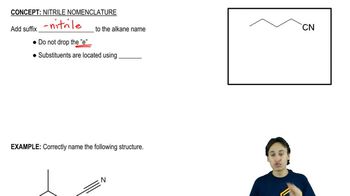
Nitriles are organic compounds containing a cyano group (-C≡N) attached to a carbon atom. They are versatile intermediates in organic synthesis, often used to form ketones through reactions with organometallic reagents. Understanding the reactivity and transformation of nitriles is crucial for predicting the outcome of such reactions.
Recommended video:
Guided course
01:01
Nitrile Nomenclature

Organometallic Reagents

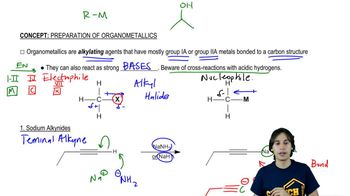
Organometallic reagents, such as Grignard reagents (RMgX) and organolithium compounds (RLi), are pivotal in organic synthesis for forming carbon-carbon bonds. These reagents react with nitriles to form ketones by nucleophilic addition, followed by hydrolysis. Recognizing the types of organometallic reagents and their reactivity is essential for selecting the appropriate reagent for ketone synthesis.
Recommended video:
Guided course
02:50
Ruining Organometallics

Ketone Formation

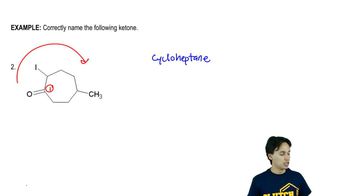
Ketones are carbonyl compounds characterized by a carbon atom double-bonded to an oxygen atom and two alkyl or aryl groups. In organic synthesis, ketones can be formed by the reaction of nitriles with organometallic reagents, which involves nucleophilic addition to the nitrile followed by hydrolysis. Understanding the mechanism of ketone formation helps in selecting the correct reagents and predicting the structure of the final product.
Recommended video:
Guided course
02:27
Name the ketone