Ch. 16 - Metals in Organic Chemistry
Mullins - Organic Chemistry: A Learner Centered Approach 1st Edition
Mullins1st EditionOrganic Chemistry: A Learner Centered ApproachISBN: 9780137566471Not the one you use?Change textbook
Chapter 15, Problem 12c

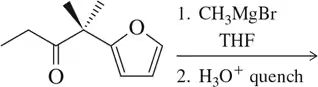
Predict the product of the following aldehyde and ketone addition reactions.


(c) Chemical reaction diagram showing the addition of CH3MgBr to an aldehyde, followed by a water quench step.

Verified step by step guidance
1
Identify the functional groups in the starting material. The molecule contains a ketone group, which is characterized by a carbonyl group (C=O) bonded to two carbon atoms.
Recognize the reagent used in the reaction. CH₃MgBr is a Grignard reagent, which is a source of nucleophilic methyl anion (CH₃⁻). It is used to add carbon groups to carbonyl compounds.
Understand the mechanism of the reaction. The Grignard reagent will attack the electrophilic carbon atom of the carbonyl group in the ketone, forming a new carbon-carbon bond.
Consider the solvent and conditions. THF is a common solvent for Grignard reactions, providing a suitable environment for the reaction to proceed. The subsequent addition of H₃O⁺ (acidic quench) will protonate the alkoxide intermediate formed after the Grignard addition.
Predict the product. The reaction will result in the formation of a tertiary alcohol, where the methyl group from the Grignard reagent is added to the carbonyl carbon, and the oxygen is converted into an alcohol group after protonation.

Verified video answer for a similar problem:

This video solution was recommended by our tutors as helpful for the problem above.
Was this helpful?

Key Concepts

Here are the essential concepts you must grasp in order to answer the question correctly.

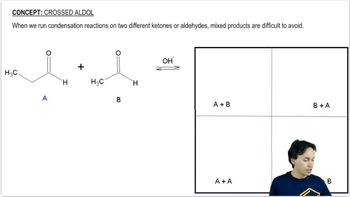
Aldol Condensation

Aldol condensation is a reaction between aldehydes and ketones that involves the formation of a β-hydroxy aldehyde or ketone, followed by dehydration to yield an α,β-unsaturated carbonyl compound. This reaction is significant in organic synthesis as it allows for the formation of larger carbon skeletons and can lead to complex molecules.
Recommended video:
Guided course
09:51
Crossed Aldol

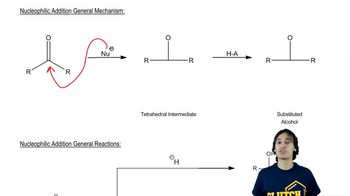
Nucleophilic Addition

Nucleophilic addition is a fundamental reaction mechanism in organic chemistry where a nucleophile attacks an electrophilic carbon atom, typically in carbonyl compounds like aldehydes and ketones. This process is crucial for understanding how these compounds react to form new bonds and products, influencing the overall reaction pathway.
Recommended video:
Guided course
08:27
Nucleophilic Addition

Reaction Mechanism

A reaction mechanism describes the step-by-step sequence of elementary reactions by which overall chemical change occurs. Understanding the mechanism of aldehyde and ketone reactions is essential for predicting products, as it reveals how reactants interact, the formation of intermediates, and the final products of the reaction.
Recommended video:
Guided course
02:16
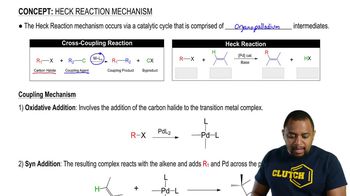
Heck Reaction Mechanism