Ch. 16 - Metals in Organic Chemistry
Mullins - Organic Chemistry: A Learner Centered Approach 1st Edition
Mullins1st EditionOrganic Chemistry: A Learner Centered ApproachISBN: 9780137566471Not the one you use?Change textbook
Chapter 15, Problem 11

Using the epoxide shown, addition of an organolithium reagent, when followed by an acid quench, produces only the starting epoxy alcohol. Why? How could the reaction be modified to produce the desired molecule? [Hint: Look back at Section 13.14.]
Chemical reaction diagram showing organolithium reagent addition to an epoxide, resulting in an epoxy alcohol as the only product.

Verified step by step guidance
1
The problem involves the reaction of an epoxide with an organolithium reagent followed by an acid quench. Begin by recalling the reactivity of epoxides: they are highly strained three-membered rings that undergo nucleophilic ring-opening reactions. Organolithium reagents are strong nucleophiles and bases, so they can attack the epoxide.
In this case, the reaction produces the starting epoxy alcohol. This suggests that the organolithium reagent is not effectively opening the epoxide ring. Instead, it is likely deprotonating the hydroxyl group of the epoxy alcohol, forming an alkoxide ion. This alkoxide ion is then reprotonated during the acid quench, regenerating the starting material.
To modify the reaction and achieve the desired product, consider protecting the hydroxyl group of the epoxy alcohol before introducing the organolithium reagent. Protecting groups, such as silyl ethers (e.g., TBDMS or TMS), can temporarily mask the hydroxyl group, preventing it from being deprotonated by the organolithium reagent.
After protecting the hydroxyl group, the organolithium reagent can attack the less sterically hindered carbon of the epoxide, leading to ring opening. This step is regioselective because organolithium reagents prefer to attack the less substituted carbon of the epoxide due to steric and electronic factors.
Finally, after the desired product is formed, the protecting group can be removed under appropriate conditions (e.g., using fluoride ions for silyl ethers) to regenerate the hydroxyl group. This sequence ensures that the reaction proceeds to the desired product rather than regenerating the starting material.

Verified video answer for a similar problem:

This video solution was recommended by our tutors as helpful for the problem above.
Was this helpful?

Key Concepts

Here are the essential concepts you must grasp in order to answer the question correctly.

Epoxide Reactivity

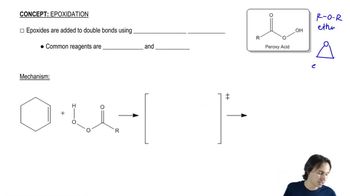
Epoxides are three-membered cyclic ethers that are highly reactive due to the strain in their ring structure. This reactivity allows them to undergo nucleophilic attack, typically at the less hindered carbon atom. Understanding how organolithium reagents interact with epoxides is crucial, as they can open the epoxide ring, leading to different products depending on the conditions used.
Recommended video:
Guided course
02:19
General properties of epoxidation.

Organolithium Reagents

Organolithium reagents are powerful nucleophiles commonly used in organic synthesis. They can react with electrophiles, such as epoxides, to form new carbon-carbon bonds. However, the outcome of the reaction can depend on the sterics and electronics of the substrate, as well as the reaction conditions, which can lead to different products or even the starting material being regenerated.
Recommended video:

Acid Quenching

Acid quenching is a technique used to terminate reactions by adding an acid, which can protonate reactive intermediates and stabilize the final product. In the context of epoxide reactions, acid quenching can influence the outcome by affecting the stability of the nucleophilic addition product. Understanding how acid quenching interacts with the reaction mechanism is essential for modifying the reaction to achieve the desired product.
Recommended video:
Guided course
02:23
Using factors affecting acidity to rank acids