
Using the epoxide shown, addition of an organolithium reagent, when followed by an acid quench, produces only the starting epoxy alcohol. Why? How could the reaction be modified to produce the desired molecule? [Hint: Look back at Section 13.14.]
Ch. 16 - Metals in Organic Chemistry

Mullins1st EditionOrganic Chemistry: A Learner Centered ApproachISBN: 9780137566471Not the one you use?Change textbook
Chapter 15, Problem 12a
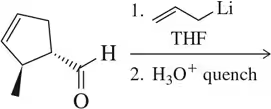
Predict the product of the following aldehyde and ketone addition reactions.
(a) 
Verified step by step guidance1
Identify the reactants: The image shows a cyclopentane ring with an aldehyde group. The reagent is an organolithium compound, specifically butyllithium (LiC4H9), in THF solvent, followed by an acid quench (H3O+).
Understand the reaction type: This is a nucleophilic addition reaction where the organolithium reagent acts as a nucleophile, attacking the electrophilic carbonyl carbon of the aldehyde.
Describe the mechanism: The butyllithium reagent will donate its butyl group to the carbonyl carbon, breaking the C=O double bond and forming an alkoxide intermediate.
Consider the quenching step: The alkoxide intermediate is then protonated by the acid (H3O+), converting it into an alcohol.
Predict the product: The final product will be a secondary alcohol, where the original aldehyde carbon now bears a hydroxyl group and the butyl group from the organolithium reagent.

Verified video answer for a similar problem:
This video solution was recommended by our tutors as helpful for the problem above.
Video duration:
3mWas this helpful?
Key Concepts
Here are the essential concepts you must grasp in order to answer the question correctly.
Aldol Condensation
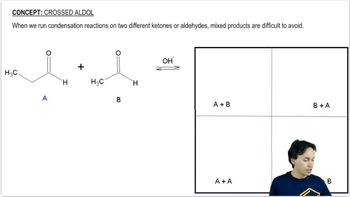
Aldol condensation is a reaction between aldehydes or ketones that contain alpha-hydrogens, leading to the formation of β-hydroxy aldehydes or ketones. This reaction involves the nucleophilic addition of an enolate ion to a carbonyl carbon, followed by dehydration to yield an α,β-unsaturated carbonyl compound. Understanding this mechanism is crucial for predicting the products of reactions involving aldehydes and ketones.
Recommended video:
Guided course
Crossed Aldol
Nucleophilic Addition
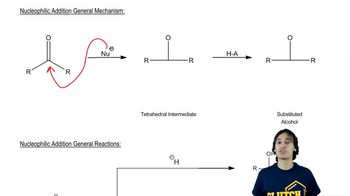
Nucleophilic addition is a fundamental reaction in organic chemistry where a nucleophile attacks an electrophilic carbon atom in a carbonyl group. In the context of aldehydes and ketones, this process leads to the formation of alcohols or other functional groups. Recognizing the role of nucleophiles and electrophiles in these reactions is essential for predicting the outcome of the addition reactions.
Recommended video:
Guided course
Nucleophilic Addition
Reaction Mechanism
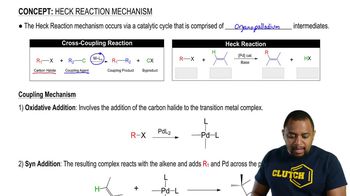
A reaction mechanism describes the step-by-step sequence of elementary reactions by which overall chemical change occurs. Understanding the mechanism of aldehyde and ketone reactions, including the formation of intermediates and transition states, is vital for predicting the final products. This knowledge allows chemists to anticipate how different conditions or reactants will influence the reaction outcome.
Recommended video:
Guided course
Heck Reaction Mechanism
Related Practice
Textbook Question
1
views
Textbook Question
Working backward, design a synthesis of the following alcohol using two different epoxide/Grignard reagent combinations.
1
views
Textbook Question
Addition to an epoxide occurs via an SN2 reaction, but the stereochemistry of the epoxide is retained in the following reaction. Why?
2
views
Textbook Question
Predict the product of the following aldehyde and ketone addition reactions.
(b)
Textbook Question
Provide an arrow-pushing mechanism for the cyclopropanation of cyclohexene with methylene carbene. Rationalize the outcome.
Textbook Question
Predict the product of the following aldehyde and ketone addition reactions.
(c)
2
views
