Ch. 16 - Metals in Organic Chemistry
Mullins - Organic Chemistry: A Learner Centered Approach 1st Edition
Mullins1st EditionOrganic Chemistry: A Learner Centered ApproachISBN: 9780137566471Not the one you use?Change textbook
Chapter 15, Problem 17

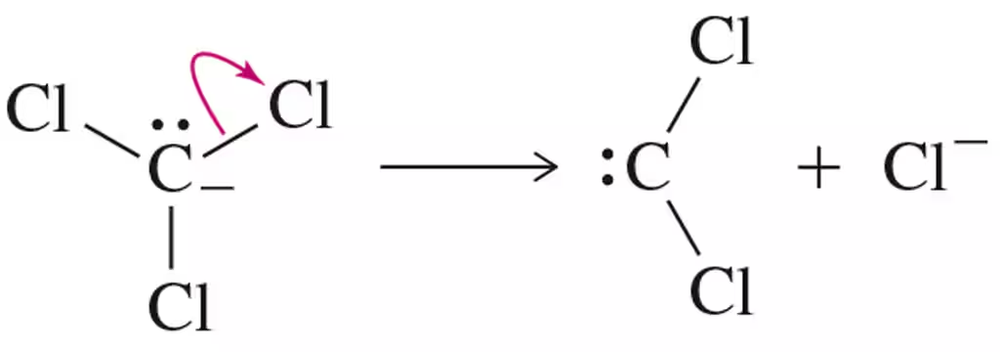
Estimate the value of entropy (∆S > 0 or ∆S < 0) for the elimination step shown.
Chemical reaction diagram showing chlorine atoms and a carbon atom, indicating an elimination step with entropy estimation.

Verified step by step guidance
1
Step 1: Understand the concept of entropy (∆S). Entropy is a measure of disorder or randomness in a system. In chemical reactions, ∆S > 0 indicates an increase in disorder, while ∆S < 0 indicates a decrease in disorder.
Step 2: Analyze the elimination reaction. Elimination reactions typically involve the removal of atoms or groups from a molecule, resulting in the formation of a double bond and often the release of smaller molecules like H₂O or HCl.
Step 3: Consider the molecular changes during the elimination step. The reactant is usually a single, larger molecule, and the products are typically a smaller molecule (e.g., H₂O or HCl) and an unsaturated molecule (e.g., an alkene). This change generally increases the number of particles in the system.
Step 4: Evaluate the impact on entropy. The increase in the number of particles and the formation of a more disordered gaseous or liquid product typically leads to an increase in entropy (∆S > 0).
Step 5: Conclude based on the analysis. For elimination reactions, the entropy change is usually positive (∆S > 0) due to the increase in disorder and the number of particles in the system.

Verified video answer for a similar problem:

This video solution was recommended by our tutors as helpful for the problem above.
Video duration:
1m
Was this helpful?

Key Concepts

Here are the essential concepts you must grasp in order to answer the question correctly.

Entropy (S)

Entropy is a measure of the disorder or randomness in a system. In thermodynamics, it quantifies the number of possible arrangements of particles in a system. A positive change in entropy (∆S > 0) indicates an increase in disorder, while a negative change (∆S < 0) suggests a decrease in disorder. Understanding entropy is crucial for predicting the spontaneity of reactions.
Recommended video:
Guided course
02:46
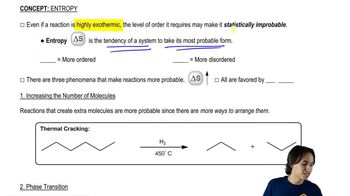
Explaining what entropy is.

Elimination Reactions

Elimination reactions are a type of organic reaction where two substituents are removed from a molecule, resulting in the formation of a double bond or a ring structure. These reactions often involve the loss of small molecules, such as water or hydrogen halides. The nature of the elimination process can significantly influence the entropy change, as the formation of gaseous products typically increases disorder.
Recommended video:
Guided course
00:40
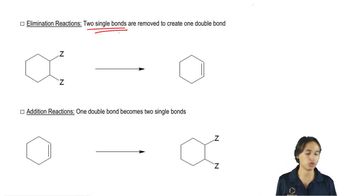
Recognizing Elimination Reactions.

Thermodynamic Favorability

Thermodynamic favorability refers to the likelihood of a reaction occurring based on changes in enthalpy (∆H) and entropy (∆S). A reaction is considered thermodynamically favorable if the Gibbs free energy change (∆G) is negative, which can occur when the increase in entropy compensates for any unfavorable enthalpic changes. Evaluating the entropy change during the elimination step is essential for determining the overall favorability of the reaction.
Recommended video:
Guided course
08:51
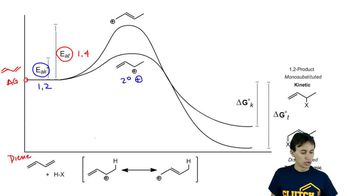
Kinetic vs. Thermodynamic Control