Ch. 13 - Alcohols, Ethers and Related Compounds: Substitution and Elimination
Mullins - Organic Chemistry: A Learner Centered Approach 1st Edition
Mullins1st EditionOrganic Chemistry: A Learner Centered ApproachISBN: 9780137566471Not the one you use?Change textbook
Chapter 12, Problem 55

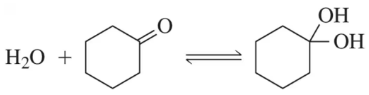
Though ketones, like aldehydes, are in equilibrium with a hydrated form, they cannot be further oxidized. Why?

Verified step by step guidance
1
Understand the structure of ketones: Ketones have a carbonyl group (C=O) bonded to two carbon atoms. This makes them less reactive towards oxidation compared to aldehydes, which have a carbonyl group bonded to at least one hydrogen atom.
Examine the hydration equilibrium: The image shows a ketone in equilibrium with its hydrated form, a geminal diol. This equilibrium involves the addition of water across the carbonyl group, forming two hydroxyl groups on the same carbon.
Consider oxidation of ketones: For oxidation to occur, there must be a hydrogen atom on the carbonyl carbon that can be removed. In ketones, both groups attached to the carbonyl carbon are carbon groups, lacking the necessary hydrogen for further oxidation.
Compare with aldehydes: Aldehydes can be oxidized to carboxylic acids because they have a hydrogen atom on the carbonyl carbon, which can be replaced by an oxygen atom during oxidation.
Conclude why ketones cannot be further oxidized: Since ketones lack the hydrogen atom on the carbonyl carbon, they cannot undergo further oxidation to form carboxylic acids or other oxidized products.

Verified video answer for a similar problem:

This video solution was recommended by our tutors as helpful for the problem above.
Video duration:
3m
Was this helpful?

Key Concepts

Here are the essential concepts you must grasp in order to answer the question correctly.

Ketones and Aldehydes

Ketones and aldehydes are both carbonyl compounds characterized by a carbon atom double-bonded to an oxygen atom. Aldehydes have at least one hydrogen atom attached to the carbonyl carbon, while ketones have two carbon groups attached. This structural difference influences their reactivity and stability, particularly in oxidation reactions.
Recommended video:
Guided course
03:57
Nucleophilic Addition on Ketones and Aldehydes

Hydration Equilibrium

Ketones and aldehydes can undergo hydration, forming their corresponding hydrate forms, which are typically more stable in aqueous solutions. This equilibrium between the carbonyl compound and its hydrate is crucial for understanding their behavior in solution, as it affects their reactivity and the extent to which they can participate in further chemical reactions.
Recommended video:
Guided course
09:11
Alkyne Hydration

Oxidation of Carbonyl Compounds

Oxidation refers to the process of increasing the oxidation state of a molecule, often involving the addition of oxygen or the removal of hydrogen. Ketones cannot be oxidized further because they already possess the highest oxidation state for a carbonyl group, while aldehydes can be oxidized to carboxylic acids. This limitation is due to the structural stability of ketones, which prevents further oxidation under typical conditions.
Recommended video:
Guided course
01:40
Defining meso compounds.