Ch. 13 - Alcohols, Ethers and Related Compounds: Substitution and Elimination
Mullins - Organic Chemistry: A Learner Centered Approach 1st Edition
Mullins1st EditionOrganic Chemistry: A Learner Centered ApproachISBN: 9780137566471Not the one you use?Change textbook
Chapter 12, Problem 56

If there is no water present, the hydrate of an aldehyde cannot form. Could an aldehyde itself (not the hydrate) be oxidized to a carboxylic acid? Why?

Verified step by step guidance
1
Understand the structure of an aldehyde: An aldehyde has the general formula RCHO, where R is a hydrocarbon group and CHO is the aldehyde functional group.
Recognize the oxidation process: Oxidation in organic chemistry typically involves the increase in the number of bonds to oxygen or the decrease in the number of bonds to hydrogen.
Identify the oxidizing agent: Common oxidizing agents for aldehydes include potassium permanganate (KMnO4), chromic acid (H2CrO4), and silver oxide (Ag2O). These agents can facilitate the conversion of an aldehyde to a carboxylic acid.
Consider the reaction mechanism: The oxidation of an aldehyde to a carboxylic acid involves the addition of an oxygen atom to the carbonyl carbon, increasing its oxidation state.
Conclude the possibility: Yes, an aldehyde can be oxidized to a carboxylic acid even without forming a hydrate, as the oxidation process directly involves the aldehyde functional group and an oxidizing agent.

Verified video answer for a similar problem:

This video solution was recommended by our tutors as helpful for the problem above.
Video duration:
4m
Was this helpful?

Key Concepts

Here are the essential concepts you must grasp in order to answer the question correctly.

Aldehyde Structure and Reactivity

Aldehydes are organic compounds characterized by the presence of a carbonyl group (C=O) bonded to a hydrogen atom and an R group. This structure makes them susceptible to oxidation, where the hydrogen atom is replaced by a hydroxyl group, forming a carboxylic acid. Understanding the reactivity of the carbonyl group is crucial for predicting oxidation reactions.
Recommended video:
Guided course
01:34
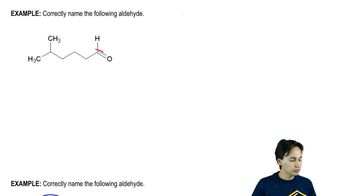
Name the aldehyde

Oxidation of Aldehydes

Oxidation is a chemical reaction involving the loss of electrons. Aldehydes can be oxidized to carboxylic acids by various oxidizing agents, such as potassium permanganate (KMnO4) or chromic acid (H2CrO4). This process involves the conversion of the aldehyde's hydrogen atom into a hydroxyl group, increasing the oxidation state of the carbon atom.
Recommended video:
Guided course
01:34
Name the aldehyde

Role of Water in Hydrate Formation

Hydrate formation involves the addition of water to an aldehyde, resulting in a geminal diol. This reaction is reversible and depends on the presence of water. While hydrates are intermediates in some oxidation reactions, the absence of water prevents their formation, but does not impede the direct oxidation of aldehydes to carboxylic acids.
Recommended video:
Guided course
09:11
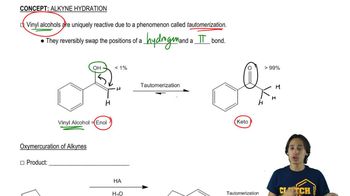
Alkyne Hydration