Ch. 13 - Alcohols, Ethers and Related Compounds: Substitution and Elimination
Mullins - Organic Chemistry: A Learner Centered Approach 1st Edition
Mullins1st EditionOrganic Chemistry: A Learner Centered ApproachISBN: 9780137566471Not the one you use?Change textbook
Chapter 12, Problem 57a

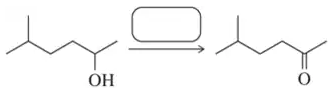
Fill in the missing reactant, reagent, or product for each of the following oxidation reactions.
(a)

Verified step by step guidance
1
Identify the type of alcohol present in the reactant. The structure shows a secondary alcohol, as the hydroxyl group (-OH) is attached to a carbon atom that is connected to two other carbon atoms.
Recognize the type of oxidation reaction. Secondary alcohols are typically oxidized to ketones.
Determine the appropriate oxidizing agent for converting a secondary alcohol to a ketone. Common reagents include PCC (Pyridinium Chlorochromate) or Jones reagent (Chromic acid, H2CrO4).
Consider the reaction conditions. PCC is often used in anhydrous conditions, while Jones reagent requires aqueous acidic conditions.
Select the reagent based on the desired reaction conditions and the specific requirements of the reaction. For this transformation, PCC is a suitable choice for oxidizing the secondary alcohol to a ketone without over-oxidation.

Verified video answer for a similar problem:

This video solution was recommended by our tutors as helpful for the problem above.
Was this helpful?

Key Concepts

Here are the essential concepts you must grasp in order to answer the question correctly.

Oxidation-Reduction Reactions

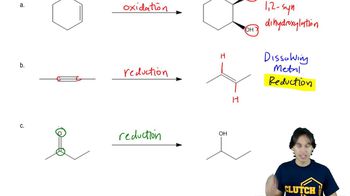
Oxidation-reduction (redox) reactions involve the transfer of electrons between substances, leading to changes in oxidation states. In these reactions, oxidation refers to the loss of electrons, while reduction refers to the gain of electrons. Understanding these processes is crucial for identifying reactants and products in organic reactions, particularly in the context of oxidation reactions.
Recommended video:
Guided course
00:54
Distinguishing between Oxidation and Reduction

Common Oxidizing Agents

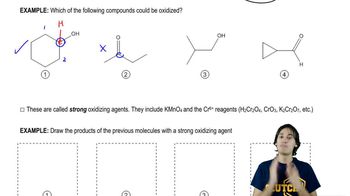
Oxidizing agents are substances that facilitate the oxidation of other compounds by accepting electrons. Common oxidizing agents in organic chemistry include potassium permanganate (KMnO4), chromium trioxide (CrO3), and hydrogen peroxide (H2O2). Recognizing these agents helps predict the products of oxidation reactions and the conditions under which they occur.
Recommended video:
Guided course
03:40
Strong oxidizing agents

Functional Group Transformations

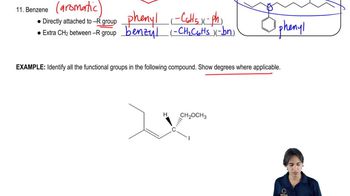
Functional group transformations are chemical reactions that convert one functional group into another, often altering the properties and reactivity of the molecule. In oxidation reactions, alcohols can be converted to aldehydes or ketones, and further to carboxylic acids. Understanding these transformations is essential for predicting the outcome of oxidation reactions and filling in missing components.
Recommended video:
Guided course
02:36
Identifying Functional Groups