Ch. 12 - Substitution and Elimination: Reactions of Haloalkanes
Mullins - Organic Chemistry: A Learner Centered Approach 1st Edition
Mullins1st EditionOrganic Chemistry: A Learner Centered ApproachISBN: 9780137566471Not the one you use?Change textbook
Chapter 11, Problem 43a

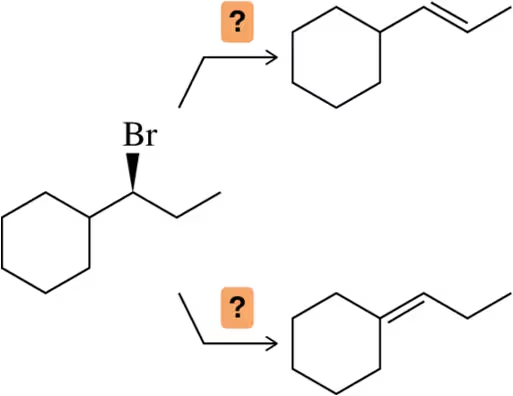
Suggest an appropriate base to synthesize the alkene as the major product from the starting haloalkane.
(a) Flowchart showing a haloalkane with a bromine atom and pathways to synthesize alkenes, with question marks indicating base suggestions.

Verified step by step guidance
1
Step 1: Understand the reaction type. The synthesis of an alkene from a haloalkane typically involves an elimination reaction (E2 or E1 mechanism). The choice of base is crucial for favoring the elimination pathway over substitution.
Step 2: Analyze the structure of the haloalkane. Determine whether the haloalkane is primary, secondary, or tertiary. This will influence the mechanism (E2 or E1) and the strength of the base required.
Step 3: Consider steric hindrance. If the haloalkane is bulky (e.g., tertiary), a strong, bulky base like potassium tert-butoxide (K⁺[CH₃]₃CO⁻) is often used to favor elimination and minimize substitution.
Step 4: Evaluate the reaction conditions. Strong bases such as sodium hydroxide (NaOH) or potassium hydroxide (KOH) can be used for E2 elimination, while weaker bases may favor E1 elimination under acidic conditions.
Step 5: Select the base based on regioselectivity. If the goal is to form the more substituted alkene (Zaitsev product), use a strong base like NaOH or KOH. If the goal is to form the less substituted alkene (Hofmann product), use a bulky base like potassium tert-butoxide.

Verified video answer for a similar problem:

This video solution was recommended by our tutors as helpful for the problem above.
Video duration:
3m
Was this helpful?

Key Concepts

Here are the essential concepts you must grasp in order to answer the question correctly.

Elimination Reactions

Elimination reactions involve the removal of a leaving group and a hydrogen atom from adjacent carbon atoms, resulting in the formation of a double bond. In the context of haloalkanes, these reactions can lead to the synthesis of alkenes. The most common types of elimination reactions are E1 and E2, which differ in their mechanisms and conditions.
Recommended video:
Guided course
00:40
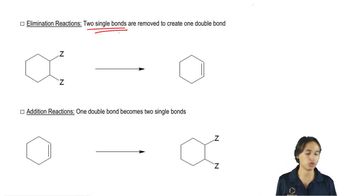
Recognizing Elimination Reactions.

Strong Bases

Strong bases are essential for promoting elimination reactions, particularly E2 mechanisms, where a strong base abstracts a proton while the leaving group departs. Common strong bases include sodium hydroxide (NaOH), potassium tert-butoxide (KOtBu), and sodium ethoxide (NaOEt). The choice of base can influence the regioselectivity and stereochemistry of the resulting alkene.
Recommended video:
Guided course
03:10
Monosaccharides - Strong Oxidation (Aldaric Acid)

Zaitsev's Rule

Zaitsev's Rule states that in elimination reactions, the more substituted alkene is typically the major product. This is due to the stability of more substituted alkenes, which are favored thermodynamically. Understanding this rule helps in predicting the outcome of reactions involving haloalkanes and the choice of base can also affect which alkene is formed.
Recommended video:
Guided course
01:18
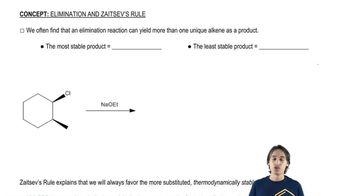
Defining Zaitsev’s Rule