Ch. 12 - Substitution and Elimination: Reactions of Haloalkanes
Mullins - Organic Chemistry: A Learner Centered Approach 1st Edition
Mullins1st EditionOrganic Chemistry: A Learner Centered ApproachISBN: 9780137566471Not the one you use?Change textbook
Chapter 11, Problem 43b

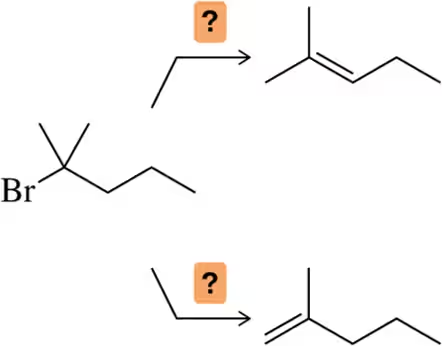
Suggest an appropriate base to synthesize the alkene as the major product from the starting haloalkane.
(b) Flowchart showing elimination reactions with a haloalkane and question marks indicating suggested bases for alkene synthesis.

Verified step by step guidance
1
Analyze the starting material: The haloalkane provided is a tertiary alkyl bromide. This structure is prone to elimination reactions due to steric hindrance, favoring the E2 mechanism over substitution.
Understand the desired product: The target molecule is an alkene, specifically the more substituted alkene, which is typically the major product due to Zaitsev's rule. Zaitsev's rule states that elimination reactions favor the formation of the more stable, highly substituted alkene.
Choose an appropriate base: To favor the E2 elimination mechanism, a strong base is required. Bulky bases like potassium tert-butoxide (KOtBu) are often used to ensure elimination rather than substitution. Additionally, bulky bases can help avoid steric hindrance and promote the formation of the desired alkene.
Consider the reaction conditions: The reaction should be carried out in a polar aprotic solvent, such as dimethyl sulfoxide (DMSO) or acetone, to facilitate the E2 mechanism. Heat is often applied to further favor elimination over substitution.
Verify the regioselectivity: Using a bulky base ensures that the elimination occurs preferentially at the β-hydrogen that leads to the formation of the more substituted alkene, consistent with Zaitsev's rule.

Verified video answer for a similar problem:

This video solution was recommended by our tutors as helpful for the problem above.
Video duration:
7m
Was this helpful?

Key Concepts

Here are the essential concepts you must grasp in order to answer the question correctly.

Elimination Reactions

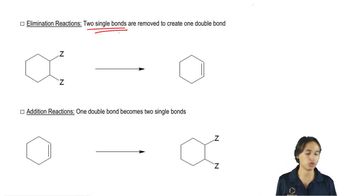
Elimination reactions involve the removal of a leaving group and a hydrogen atom from adjacent carbon atoms, resulting in the formation of a double bond. In organic chemistry, these reactions are crucial for synthesizing alkenes from haloalkanes. The most common types are E1 and E2 mechanisms, which differ in their reaction pathways and conditions.
Recommended video:
Guided course
00:40
Recognizing Elimination Reactions.

Base Selection

The choice of base is critical in elimination reactions, as it influences the reaction mechanism and the major product formed. Strong bases, such as sodium ethoxide or potassium tert-butoxide, favor E2 mechanisms, leading to the formation of alkenes. The sterics and electronics of the base can also affect regioselectivity and the stability of the resulting alkene.
Recommended video:
1:23
Nitrogenous Bases Example 3

Regioselectivity

Regioselectivity refers to the preference of a chemical reaction to yield one structural isomer over others. In elimination reactions, this concept is important when determining which alkene product is favored. The Zaitsev's rule states that the more substituted alkene is typically the major product, while the Hofmann rule applies when sterically hindered bases are used, leading to less substituted alkenes.
Recommended video:
Guided course
05:09
Heck Reaction