Ch. 12 - Substitution and Elimination: Reactions of Haloalkanes
Mullins - Organic Chemistry: A Learner Centered Approach 1st Edition
Mullins1st EditionOrganic Chemistry: A Learner Centered ApproachISBN: 9780137566471Not the one you use?Change textbook
Chapter 11, Problem 42d

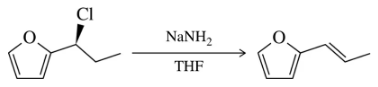
Show a mechanism for the following elimination reactions. Label the mechanism as E1 or E2.
(d)

Verified step by step guidance
1
Step 1: Identify the type of elimination mechanism. The reaction involves NaNH₂, a strong base, and THF as the solvent. This suggests an E2 elimination mechanism, as E2 typically occurs with strong bases and does not involve a carbocation intermediate.
Step 2: Analyze the substrate. The substrate contains a chlorine atom attached to a carbon adjacent to a β-hydrogen. The β-hydrogen is necessary for elimination to occur, as it will be abstracted by the base.
Step 3: Describe the E2 mechanism. In an E2 reaction, the strong base (NaNH₂) abstracts the β-hydrogen, and simultaneously, the leaving group (Cl) departs. This results in the formation of a double bond between the α and β carbons.
Step 4: Consider stereochemistry. The E2 mechanism requires the β-hydrogen and the leaving group to be anti-periplanar (in opposite planes). Ensure the molecular geometry allows for this arrangement before elimination occurs.
Step 5: Draw the product. After the elimination, the product is a conjugated diene with a double bond formed between the α and β carbons. The oxygen atom in the furan ring remains unaffected during the reaction.

Verified video answer for a similar problem:

This video solution was recommended by our tutors as helpful for the problem above.
Was this helpful?

Key Concepts

Here are the essential concepts you must grasp in order to answer the question correctly.

Elimination Reactions

Elimination reactions involve the removal of a leaving group and a hydrogen atom from adjacent carbon atoms, resulting in the formation of a double bond. These reactions can be classified as either E1 or E2, depending on the mechanism. E1 reactions are unimolecular and proceed through a carbocation intermediate, while E2 reactions are bimolecular and involve a concerted mechanism where the bond formation and bond breaking occur simultaneously.
Recommended video:
Guided course
00:40
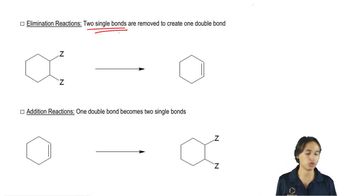
Recognizing Elimination Reactions.

E1 vs. E2 Mechanisms

The E1 mechanism is characterized by two steps: first, the formation of a carbocation after the leaving group departs, followed by deprotonation to form the double bond. In contrast, the E2 mechanism occurs in a single step where the base abstracts a proton while the leaving group exits, leading to the formation of the double bond. The choice between E1 and E2 depends on factors such as substrate structure, the strength of the base, and the reaction conditions.
Recommended video:
Guided course
09:36
Drawing the E2 Mechanism.

Role of Sodium Amide (NaNH2)

Sodium amide (NaNH2) is a strong base commonly used in elimination reactions. It facilitates the removal of protons from the substrate, promoting the formation of double bonds in E2 mechanisms. In the context of the provided reaction, NaNH2 acts to deprotonate the substrate after the leaving group (Cl) departs, leading to the formation of the alkene product. Its strength as a base is crucial for driving the elimination process.
Recommended video:
Guided course
01:33
Amide Nomenclature