Ch. 12 - Substitution and Elimination: Reactions of Haloalkanes
Mullins - Organic Chemistry: A Learner Centered Approach 1st Edition
Mullins1st EditionOrganic Chemistry: A Learner Centered ApproachISBN: 9780137566471Not the one you use?Change textbook
Chapter 11, Problem 42a

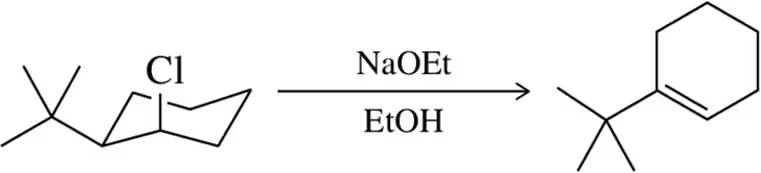
Show a mechanism for the following elimination reactions. Label the mechanism as E1 or E2.
(a) Diagram illustrating an E1 or E2 elimination reaction mechanism with reactants and products labeled.

Verified step by step guidance
1
Step 1: Determine whether the reaction follows an E1 or E2 mechanism. E1 is a two-step process involving the formation of a carbocation intermediate, while E2 is a one-step process where the base removes a proton as the leaving group departs simultaneously. Analyze the substrate, base strength, and reaction conditions to decide.
Step 2: If the mechanism is E1, begin by identifying the leaving group and show its departure to form a carbocation intermediate. Use curved arrows to indicate the movement of electrons. If the mechanism is E2, identify the proton to be abstracted by the base and show the simultaneous departure of the leaving group and formation of the double bond.
Step 3: For E1, assess the stability of the carbocation intermediate. If necessary, consider rearrangements (e.g., hydride or alkyl shifts) to form a more stable carbocation. For E2, ensure the anti-periplanar geometry of the proton and leaving group, which is required for the elimination to occur.
Step 4: Illustrate the formation of the double bond in the product. For E1, show the base abstracting a proton from the carbocation intermediate, leading to the formation of the double bond. For E2, show the base abstracting the proton simultaneously as the leaving group departs.
Step 5: Label the mechanism clearly as E1 or E2 based on the steps you have outlined. Ensure the final product is consistent with the elimination reaction and verify that the stereochemistry (if applicable) aligns with the mechanism.

Verified video answer for a similar problem:

This video solution was recommended by our tutors as helpful for the problem above.
Video duration:
4m
Was this helpful?

Key Concepts

Here are the essential concepts you must grasp in order to answer the question correctly.

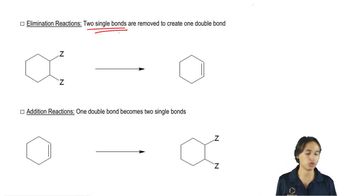
Elimination Reactions

Elimination reactions are a type of organic reaction where two substituents are removed from a molecule, resulting in the formation of a double bond. These reactions are crucial in organic synthesis and can be classified into two main types: E1 and E2, which differ in their mechanisms and kinetics. Understanding the conditions and substrates that favor each type is essential for predicting the outcome of the reaction.
Recommended video:
Guided course
00:40
Recognizing Elimination Reactions.

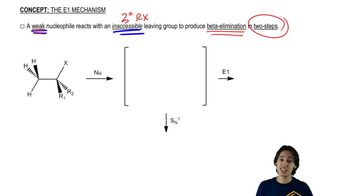
E1 Mechanism

The E1 mechanism, or unimolecular elimination, involves a two-step process where the first step is the formation of a carbocation intermediate after the leaving group departs. This is followed by the deprotonation of a neighboring carbon to form a double bond. E1 reactions are typically favored in polar protic solvents and with tertiary substrates due to the stability of the carbocation formed.
Recommended video:
Guided course
08:09
Drawing the E1 Mechanism.

E2 Mechanism

The E2 mechanism, or bimolecular elimination, occurs in a single concerted step where the base abstracts a proton while the leaving group departs simultaneously. This mechanism requires a strong base and is favored by sterically accessible substrates. E2 reactions are characterized by their dependence on both the substrate and the base, making them more predictable in terms of regioselectivity and stereochemistry.
Recommended video:
Guided course
09:36
Drawing the E2 Mechanism.