Ch. 11 - Properties and Synthesis of Alkyl Halides: Radical Reactions
Mullins - Organic Chemistry: A Learner Centered Approach 1st Edition
Mullins1st EditionOrganic Chemistry: A Learner Centered ApproachISBN: 9780137566471Not the one you use?Change textbook
Chapter 10, Problem 46b

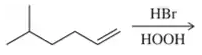
Predict the product of the following alkene addition reactions.
(b)

Verified step by step guidance
1
Identify the type of reaction: The presence of HBr and HOOH indicates a radical addition reaction, specifically anti-Markovnikov addition due to the presence of peroxide (HOOH).
Understand the mechanism: In anti-Markovnikov addition, the bromine atom will add to the less substituted carbon of the double bond, opposite to the Markovnikov rule.
Initiation step: Peroxides decompose to form radicals, which initiate the radical chain reaction. The peroxide radical abstracts a hydrogen from HBr, generating a bromine radical.
Propagation step: The bromine radical adds to the less substituted carbon of the alkene, forming a new radical at the more substituted carbon.
Termination step: The radical formed can react with another bromine radical or other radicals present to form the final product, completing the anti-Markovnikov addition.

Verified video answer for a similar problem:

This video solution was recommended by our tutors as helpful for the problem above.
Video duration:
1m
Was this helpful?

Key Concepts

Here are the essential concepts you must grasp in order to answer the question correctly.

Alkene Reactivity

Alkenes are unsaturated hydrocarbons characterized by at least one carbon-carbon double bond. This double bond is reactive and can undergo various addition reactions, where atoms or groups are added across the double bond. Understanding the nature of the alkene and the conditions of the reaction is crucial for predicting the products formed.
Recommended video:
2:09
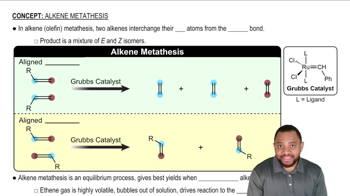
Alkene Metathesis Concept 1

Markovnikov's Rule

Markovnikov's Rule states that in the addition of HX (where X is a halogen) to an alkene, the hydrogen atom will attach to the carbon with the greater number of hydrogen atoms already attached. This principle helps predict the regioselectivity of the reaction, guiding the formation of the more stable carbocation intermediate during the reaction process.
Recommended video:
Guided course
03:54
The 18 and 16 Electron Rule

Stereochemistry of Addition Reactions

Addition reactions of alkenes can lead to different stereochemical outcomes, including syn and anti addition. The stereochemistry is important for determining the configuration of the product, especially in reactions involving chiral centers. Understanding how the addition mechanism affects stereochemistry is essential for predicting the final product's structure.
Recommended video:
1:38
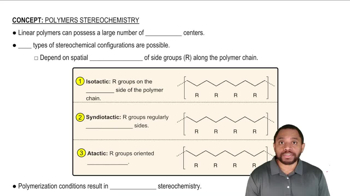
Polymer Stereochemistry Concept 1