Ch. 11 - Properties and Synthesis of Alkyl Halides: Radical Reactions
Mullins - Organic Chemistry: A Learner Centered Approach 1st Edition
Mullins1st EditionOrganic Chemistry: A Learner Centered ApproachISBN: 9780137566471Not the one you use?Change textbook
Chapter 10, Problem 45c

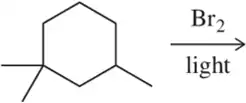
Predict the major product of the following bromination reactions.
(c) Cyclohexane with methyl groups reacts with Br2 under light, indicating a radical bromination process.

Verified step by step guidance
1
Identify the type of bromination reaction: In organic chemistry, bromination typically involves the addition of bromine (Br₂) to a compound. The reaction can be either radical bromination or electrophilic addition, depending on the substrate.
Determine the substrate structure: Analyze the given substrate to understand its structure. Is it an alkane, alkene, or aromatic compound? This will influence the mechanism of bromination.
Select the appropriate mechanism: For alkanes, radical bromination is common, where a bromine radical abstracts a hydrogen atom. For alkenes, electrophilic addition occurs, where the π bond attacks a bromine molecule, forming a bromonium ion intermediate.
Consider regioselectivity and stereochemistry: In radical bromination, the most stable radical intermediate will form, often leading to the most substituted alkyl bromide. In electrophilic addition, Markovnikov's rule applies, where the bromine adds to the more substituted carbon.
Predict the major product: Based on the mechanism and regioselectivity, predict the structure of the major product. Ensure to consider any possible rearrangements or stereochemical outcomes if applicable.

Verified video answer for a similar problem:

This video solution was recommended by our tutors as helpful for the problem above.
Video duration:
3m
Was this helpful?

Key Concepts

Here are the essential concepts you must grasp in order to answer the question correctly.

Electrophilic Aromatic Substitution

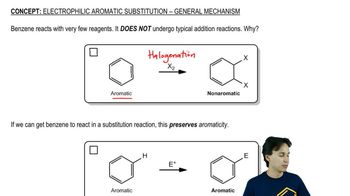
Electrophilic Aromatic Substitution (EAS) is a reaction mechanism where an aromatic ring, such as benzene, undergoes substitution by an electrophile. In bromination, the aromatic ring reacts with bromine in the presence of a catalyst like FeBr3, facilitating the formation of a bromonium ion that substitutes a hydrogen atom on the ring, maintaining aromaticity.
Recommended video:

Regioselectivity in Aromatic Substitution

Regioselectivity refers to the preference of a chemical reaction to yield a particular structural isomer when multiple possibilities exist. In bromination of substituted aromatic rings, the position of the substituents influences the site of electrophilic attack, often favoring ortho and para positions due to resonance and steric effects, especially if the substituent is an electron-donating group.
Recommended video:
Guided course
08:19
Intro to Aromaticity

Activating and Deactivating Groups

Substituents on an aromatic ring can be classified as activating or deactivating based on their ability to donate or withdraw electrons. Activating groups, like -OH or -NH2, increase the ring's reactivity towards electrophiles and direct substitution to ortho/para positions. Deactivating groups, such as -NO2, withdraw electrons, making the ring less reactive and often directing substitution to the meta position.
Recommended video:
Guided course
03:27
Activating and deactivating groups