Ch. 11 - Properties and Synthesis of Alkyl Halides: Radical Reactions
Mullins - Organic Chemistry: A Learner Centered Approach 1st Edition
Mullins1st EditionOrganic Chemistry: A Learner Centered ApproachISBN: 9780137566471Not the one you use?Change textbook
Chapter 10, Problem 46a

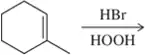
Predict the product of the following alkene addition reactions.
(a) Cyclohexene reacts with HBr in the presence of HOOH, illustrating anti-Markovnikov addition.

Verified step by step guidance
1
Identify the type of alkene addition reaction. Common types include hydrohalogenation, hydration, halogenation, and hydroboration-oxidation. Each type of reaction has a specific mechanism and product outcome.
Determine the regiochemistry of the reaction. For example, in hydrohalogenation, Markovnikov's rule often applies, where the hydrogen atom adds to the less substituted carbon of the double bond, and the halogen adds to the more substituted carbon.
Consider the stereochemistry of the reaction. Some reactions may lead to syn or anti addition, affecting the spatial arrangement of the atoms in the product.
Draw the mechanism of the reaction step-by-step. This includes showing the movement of electrons, formation of intermediates, and the final product. Use curved arrows to indicate electron flow.
Verify the stability of the product. Check for any possible rearrangements or resonance stabilization that might occur during the reaction, ensuring the most stable product is formed.

Verified video answer for a similar problem:

This video solution was recommended by our tutors as helpful for the problem above.
Video duration:
3m
Was this helpful?

Key Concepts

Here are the essential concepts you must grasp in order to answer the question correctly.

Alkene Addition Reactions

Alkene addition reactions involve the addition of atoms or groups to the carbon-carbon double bond in alkenes, converting them into saturated compounds. Common types include hydrogenation, halogenation, and hydrohalogenation, each with specific reagents and conditions that dictate the product formed.
Recommended video:
2:35
Addition Reactions of Furan Concept 2

Markovnikov's Rule

Markovnikov's Rule predicts the regiochemistry of addition reactions to alkenes, stating that in the addition of HX (where X is a halogen) to an unsymmetrical alkene, the hydrogen atom will attach to the carbon with more hydrogen substituents, while the halogen will attach to the carbon with fewer hydrogen substituents.
Recommended video:
Guided course
03:54
The 18 and 16 Electron Rule

Carbocation Stability

Carbocation stability is crucial in determining the pathway and outcome of alkene addition reactions. Tertiary carbocations are more stable than secondary, which are more stable than primary, due to hyperconjugation and inductive effects. This stability influences the formation of intermediates and the final product in reactions like hydrohalogenation.
Recommended video:
Guided course
05:58
Determining Carbocation Stability