Ch. 11 - Properties and Synthesis of Alkyl Halides: Radical Reactions
Mullins - Organic Chemistry: A Learner Centered Approach 1st Edition
Mullins1st EditionOrganic Chemistry: A Learner Centered ApproachISBN: 9780137566471Not the one you use?Change textbook
Chapter 10, Problem 45b

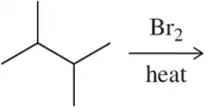
Predict the major product of the following bromination reactions.
(b) Chemical reaction: isobutane reacts with bromine (Br2) under heat to form a brominated product.

Verified step by step guidance
1
Identify the type of bromination reaction: Bromination can occur through radical substitution or electrophilic addition, depending on the substrate. For alkanes, radical bromination is common, while for alkenes, electrophilic addition is typical.
Determine the substrate structure: Analyze the given substrate to identify if it is an alkane, alkene, or another type of organic molecule. This will guide the mechanism of bromination.
Consider regioselectivity and stereoselectivity: In radical bromination, the most stable radical intermediate is favored, often leading to bromination at the most substituted carbon. In electrophilic addition to alkenes, Markovnikov's rule applies, where the bromine adds to the more substituted carbon.
Draw the mechanism: For radical bromination, initiate with the formation of bromine radicals, followed by propagation steps where the radical abstracts a hydrogen and bromine adds to the carbon. For electrophilic addition, show the formation of a carbocation intermediate and subsequent bromine addition.
Predict the major product: Based on the mechanism and the stability of intermediates, predict the structure of the major product. Consider any possible rearrangements or side reactions that might influence the outcome.

Verified video answer for a similar problem:

This video solution was recommended by our tutors as helpful for the problem above.
Video duration:
2m
Was this helpful?

Key Concepts

Here are the essential concepts you must grasp in order to answer the question correctly.

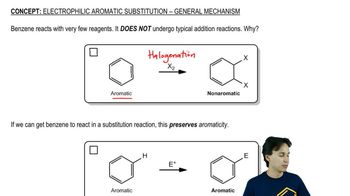
Electrophilic Aromatic Substitution

Electrophilic aromatic substitution is a reaction where an electrophile replaces a hydrogen atom in an aromatic ring. In bromination, bromine acts as the electrophile, facilitated by a catalyst like FeBr3, which helps generate the active bromine species. Understanding this mechanism is crucial for predicting the position and nature of the substitution on the aromatic ring.
Recommended video:

Regioselectivity in Aromatic Substitution

Regioselectivity refers to the preference for a chemical reaction to occur at one location over others in a molecule. In aromatic bromination, the position of substitution is influenced by existing substituents on the ring, which can be activating or deactivating and ortho/para or meta-directing. Identifying these effects helps predict the major product's structure.
Recommended video:
Guided course
08:19
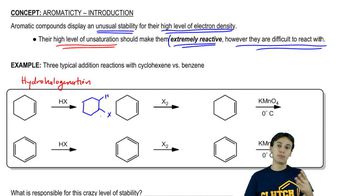
Intro to Aromaticity

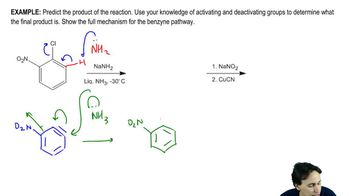
Activating and Deactivating Groups

Activating groups increase the reactivity of the aromatic ring towards electrophilic substitution, often directing the electrophile to ortho and para positions. Deactivating groups reduce reactivity and typically direct substitution to the meta position. Recognizing these groups in the substrate is essential for determining the major product in bromination reactions.
Recommended video:
Guided course
03:27
Activating and deactivating groups