Ch. 11 - Properties and Synthesis of Alkyl Halides: Radical Reactions
Mullins - Organic Chemistry: A Learner Centered Approach 1st Edition
Mullins1st EditionOrganic Chemistry: A Learner Centered ApproachISBN: 9780137566471Not the one you use?Change textbook
Chapter 10, Problem 30c

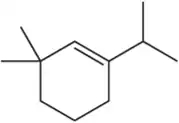
In the following molecules, identify the carbon where the radical is most likely to form in the first propagation step.
(c) Chemical structure of a cyclohexene ring with methyl groups at positions 1 and 3, and a double bond between positions 2 and 3.

Verified step by step guidance
1
Identify the structure of the molecule given in part (c). Look for any functional groups or structural features that might influence radical formation.
Consider the stability of radicals. Radicals are more stable on tertiary carbons compared to secondary or primary carbons due to hyperconjugation and the inductive effect.
Examine the molecule for resonance stabilization. Radicals that can be stabilized by resonance are more likely to form. Look for allylic or benzylic positions where resonance can occur.
Evaluate the steric hindrance around potential radical sites. Less sterically hindered sites are more favorable for radical formation.
Determine the most likely carbon for radical formation by combining the factors of stability, resonance, and steric effects. This carbon will be the site where the radical is most likely to form in the first propagation step.

Verified video answer for a similar problem:

This video solution was recommended by our tutors as helpful for the problem above.
Video duration:
3m
Was this helpful?

Key Concepts

Here are the essential concepts you must grasp in order to answer the question correctly.

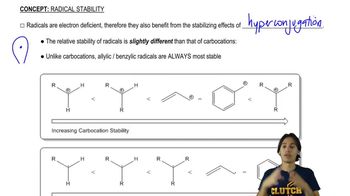
Radical Stability

Radical stability is crucial in determining where a radical is most likely to form. Radicals are more stable when they are tertiary, secondary, or allylic due to hyperconjugation and resonance effects. The stability of a radical influences its formation during chemical reactions, particularly in propagation steps.
Recommended video:
Guided course
03:43
The radical stability trend.

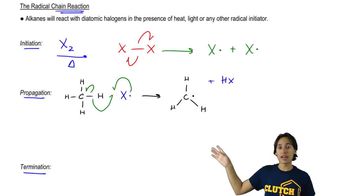
Propagation Step in Radical Reactions

The propagation step in radical reactions involves the transfer of a radical from one molecule to another, continuing the chain reaction. This step is essential for the progression of radical reactions, where the most stable radical formation is favored to ensure the reaction proceeds efficiently.
Recommended video:
Guided course
12:11
Radical Chain Reaction Mechanism.

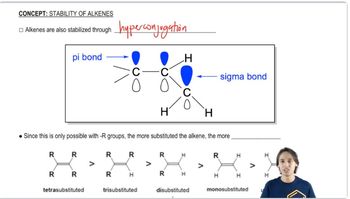
Hyperconjugation

Hyperconjugation is a stabilizing interaction that occurs when electrons in sigma bonds (typically C-H or C-C) delocalize into an adjacent empty or partially filled p-orbital or pi-system. This effect increases the stability of radicals, particularly in tertiary carbons, by dispersing electron density and reducing energy.
Recommended video:
Guided course
04:28
Understanding trends of alkene stability.