Ch. 11 - Properties and Synthesis of Alkyl Halides: Radical Reactions
Mullins - Organic Chemistry: A Learner Centered Approach 1st Edition
Mullins1st EditionOrganic Chemistry: A Learner Centered ApproachISBN: 9780137566471Not the one you use?Change textbook
Chapter 10, Problem 27c

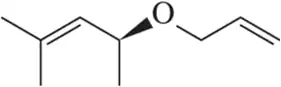
Identify the allylic carbon(s) in the following molecules.
(c) Structural representation of molecules with a highlighted allylic carbon and an oxygen atom.

Verified step by step guidance
1
Step 1: Understand the concept of allylic carbons. Allylic carbons are the carbons directly adjacent to a carbon-carbon double bond (C=C). These carbons are often involved in resonance stabilization due to their proximity to the π-electrons of the double bond.
Step 2: Examine the molecule provided. Identify all the carbon-carbon double bonds (C=C) in the structure. In this molecule, there are two double bonds present.
Step 3: Locate the carbons directly adjacent to each double bond. For each double bond, look at the carbons that are bonded to the sp2-hybridized carbons forming the double bond.
Step 4: Highlight the allylic carbons. For the first double bond on the left, the allylic carbons are the ones directly connected to the sp2 carbons of the double bond. Similarly, for the second double bond on the right, identify the carbons directly adjacent to the sp2 carbons.
Step 5: Verify your identification. Ensure that the carbons you have identified are indeed adjacent to the double bonds and not part of the double bond itself. These allylic carbons are important in reactions such as allylic substitution and resonance stabilization.

Verified video answer for a similar problem:

This video solution was recommended by our tutors as helpful for the problem above.
Video duration:
3m
Was this helpful?

Key Concepts

Here are the essential concepts you must grasp in order to answer the question correctly.

Allylic Carbons

Allylic carbons are the carbon atoms that are directly adjacent to a carbon-carbon double bond (alkene). In a molecule, these carbons are significant because they can participate in various chemical reactions, such as allylic substitution, due to their unique reactivity. Identifying allylic carbons is crucial for understanding reaction mechanisms and predicting the behavior of organic compounds.
Recommended video:
Guided course
00:48
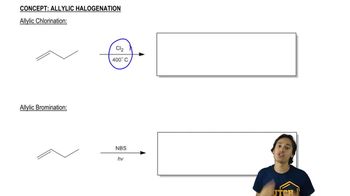
The products of Allylic Chlorination.

Alkenes

Alkenes are hydrocarbons that contain at least one carbon-carbon double bond. This double bond is responsible for the unsaturation in the molecule, which affects its reactivity and physical properties. The presence of alkenes in a structure often indicates potential sites for chemical reactions, making them important in organic synthesis and industrial applications.
Recommended video:
2:09
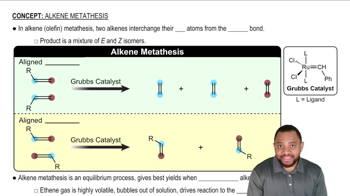
Alkene Metathesis Concept 1

Structural Representation

Structural representation in organic chemistry refers to the way molecules are depicted, showing the arrangement of atoms and the bonds between them. Understanding these representations, such as Lewis structures or skeletal formulas, is essential for visualizing molecular geometry and predicting reactivity. Accurate interpretation of these structures allows chemists to identify functional groups and key features like allylic positions.
Recommended video:
Guided course
05:09
Representations of L-Configuration