Ch. 11 - Properties and Synthesis of Alkyl Halides: Radical Reactions
Mullins - Organic Chemistry: A Learner Centered Approach 1st Edition
Mullins1st EditionOrganic Chemistry: A Learner Centered ApproachISBN: 9780137566471Not the one you use?Change textbook
Chapter 10, Problem 31a

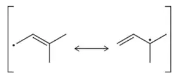
In the following allylic radicals, identify the carbon where the new C–Br bond is most likely to form in the second propagation step.
(a)

Verified step by step guidance
1
Identify the structure of the allylic radical. The image shows two resonance structures of an allylic radical, where the unpaired electron is delocalized over the allylic position.
Understand the concept of resonance. Resonance in organic chemistry refers to the delocalization of electrons across adjacent atoms, which stabilizes the molecule. In allylic radicals, the unpaired electron can be shared between the two carbon atoms adjacent to the double bond.
Determine the most stable position for the new bond formation. In the case of allylic radicals, the new bond is most likely to form at the carbon atom where the radical is most stable due to resonance stabilization.
Consider the electronic effects. The formation of the C–Br bond will occur at the carbon atom that can best stabilize the positive charge that results from the radical's electron pairing with the bromine atom.
Select the carbon atom for bond formation. Based on resonance structures, the new C–Br bond is most likely to form at the carbon atom that is part of the more stable resonance structure, which is typically the less substituted carbon in the allylic position.

Verified video answer for a similar problem:

This video solution was recommended by our tutors as helpful for the problem above.
Video duration:
2m
Was this helpful?

Key Concepts

Here are the essential concepts you must grasp in order to answer the question correctly.

Allylic Radical Stability

Allylic radicals are stabilized by resonance, where the unpaired electron is delocalized over adjacent pi bonds. This delocalization increases the stability of the radical, making allylic positions favorable sites for reactions. Understanding this stability is crucial for predicting where new bonds will form in radical reactions.
Recommended video:
Guided course
03:43
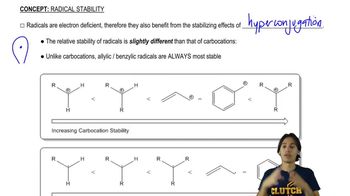
The radical stability trend.

Resonance Structures

Resonance structures depict the delocalization of electrons within a molecule, showing different possible configurations. In the case of allylic radicals, resonance allows the radical to be distributed over multiple carbon atoms, influencing the site of bond formation. Recognizing resonance structures helps in identifying the most reactive sites in a molecule.
Recommended video:
Guided course
03:04
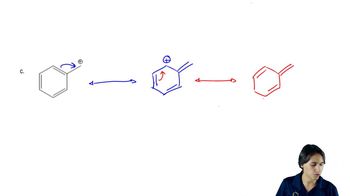
Drawing Resonance Structures

Radical Propagation Steps

Radical propagation involves the transfer of an unpaired electron to form new bonds, typically in a chain reaction. In the second propagation step, the radical reacts with another molecule, such as Br2, to form a new C–Br bond. Understanding the mechanism of propagation steps is essential for predicting the outcome of radical reactions.
Recommended video:
1:01
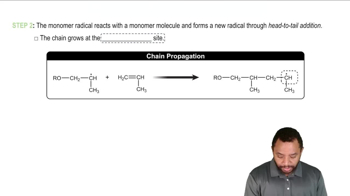
Radical Polymerization Concept 3