Ch. 10 - Alkynes: Electrophilic Addition and Redox Reactions
Mullins - Organic Chemistry: A Learner Centered Approach 1st Edition
Mullins1st EditionOrganic Chemistry: A Learner Centered ApproachISBN: 9780137566471Not the one you use?Change textbook
Chapter 9, Problem 38

Draw the ketone(s) you would expect to form by treating the following alkynes under the conditions of hydroboration–oxidation: (a) 6-methyloct-1-yne, (b) 1,10-dicyclohexyldec-5-yne, and (c) 5-phenylhex-2-yne.
<IMAGE>

Verified step by step guidance
1
Step 1: Understand the reaction mechanism. Hydroboration–oxidation of alkynes involves the addition of borane (BH₃) to the triple bond, followed by oxidation with hydrogen peroxide (H₂O₂) in the presence of sodium hydroxide (NaOH). This reaction converts the alkyne into a ketone via anti-Markovnikov addition.
Step 2: Analyze the structure of the alkyne. For each alkyne provided, identify the triple bond and determine the regioselectivity of the reaction. Hydroboration–oxidation typically results in the formation of a ketone at the less substituted carbon of the triple bond.
Step 3: For (a) 6-methyloct-1-yne, locate the triple bond between carbons 1 and 2. The hydroboration–oxidation will yield a ketone at the terminal carbon (C1), as it is less substituted. Draw the resulting ketone structure.
Step 4: For (b) 1,10-dicyclohexyldec-5-yne, locate the triple bond between carbons 5 and 6. The hydroboration–oxidation will yield a ketone at carbon 5, as it is less substituted compared to carbon 6. Draw the resulting ketone structure.
Step 5: For (c) 5-phenylhex-2-yne, locate the triple bond between carbons 2 and 3. The hydroboration–oxidation will yield a ketone at carbon 2, as it is less substituted compared to carbon 3. Draw the resulting ketone structure.

Verified video answer for a similar problem:

This video solution was recommended by our tutors as helpful for the problem above.
Video duration:
6m
Was this helpful?

Key Concepts

Here are the essential concepts you must grasp in order to answer the question correctly.

Hydroboration-Oxidation

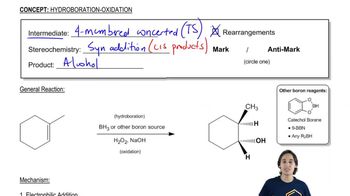
Hydroboration-oxidation is a two-step reaction process used to convert alkynes into carbonyl compounds, specifically ketones or aldehydes. In the first step, borane (BH₃) adds across the triple bond of the alkyne, forming a trialkylborane intermediate. The second step involves oxidation with hydrogen peroxide (H₂O₂) and a base (NaOH), which converts the boron atom into a hydroxyl group, yielding the corresponding ketone or aldehyde.
Recommended video:
Guided course
06:38
General properties of hydroboration-oxidation.

Alkyne Reactivity

Alkynes are hydrocarbons containing a carbon-carbon triple bond, which makes them highly reactive. Their reactivity allows them to undergo various addition reactions, including hydroboration. The position of the triple bond and the substituents on the alkyne influence the regioselectivity of the reaction, determining whether a ketone or aldehyde is formed after oxidation.
Recommended video:
Guided course
09:11
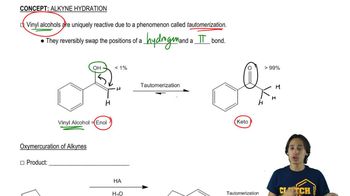
Alkyne Hydration

Regioselectivity

Regioselectivity refers to the preference of a chemical reaction to yield one structural isomer over others when multiple products are possible. In the context of hydroboration-oxidation of alkynes, the regioselectivity is influenced by the sterics and electronics of the substituents on the alkyne. This concept is crucial for predicting the specific ketone products formed from the given alkynes in the question.
Recommended video:
Guided course
05:09
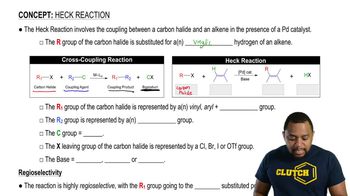
Heck Reaction